Monday, 13 April 2015

The Patterdale Murder

Having read a number of Lakeland mining books recently, I was reading about the Greenside mine in Glenridding. This book is  written by Ian Tyler (the authority on mining history in lakeland) and is well worth a read to understand the history of the village and the mines around the area. In this book you will read of lead and silver, hard won in the hills of Greenside and the rest of the valley. One part the author drew my attention to was an incident that occurred on 8th March 1835 in Patterdale that I knew nothing about. This was the murder that occurred as a result of a brawl following a long waited for pay day. Pay was handed out at The Angel Pub in Penrith and was handed out every six months. One can imagine the bonanza that would have been to men used to tearing out a living from the hard underground rock that is Greenside, Glenridding. One part of the authors account I was troubled with was that the two miners, Joseph Bainbridge and John Greenwell, were brawling with locals and were ejected from The White Lion Inn, Patterdale, were later in Chitty Puss Lane (directly opposite the public house) and in order to protect themselves, they cut and whittled sticks to use to defend themselves, if set upon. Below is a photo of Chitty Puss Lane which is directly opposite the pub. My trouble was

 'Why would you remain in the area of the assault, hunting out a stick and whittling away when all you need to do is put distance between yourself and the scene of the trouble'. 

When one young man, a Thomas Grisdale of Hartsop Hall, came out of the pub the account reads that John Greenwell, using Joseph Bainbridge's knife, 'defended' himself and stabbed Thomas Grisdale, who incidentally had nothing to do with the original disturbance in the pub.

Chitty Puss Lane
It was my intention to research this for a fuller and more believable account. My wife began checking the internet for me before I engaged on any visit to Carlisle Archives and she did a sterling job, finding a whole history of the Grisdale Family and this account was covered in great detail. Not wishing to plagiarise another's work I will simply provide you with a link to that page of this detailed family history:

https://grisdalefamily.wordpress.com/2014/08/03/murder-at-the-white-lion-inn-in-patterdale/

This goes into great detail on the actual events of the day, the eventual trial of both men with Bainbridge receiving a 'Not Guilty' verdict and Greenwell a 'Guilty', sentenced to death yet later commuted to transportation for life. This has close similarities to the 'Banished' series that was aired on BBC2. On that commuted sentence the Grisdale Family website notes he was given a conditional pardon, this was in January 1849. This differs from a Full Pardon in that if he ever returned to his homeland tehn the original sentence was implemented; that was not transportation, but the hangman's noose. I have researche a number who returned and that terrible sentence was carried out. John had been released in March 1844, having obtained a 'ticket of leave, basically parole.

I will leave that article to fully explain but in the interests of enlightenment I draw the incident to your attention and the next time you have a pint in The White Lion you may choose to reflect on those events to add the your days experience.

One final addition is I visited Glenridding churchyard and found the grave of Thomas Grisdale, the pain of the family bites into your soul through the inscription carved into the hard green slate. I include a photograph of the stone and the inscription it holds.

Thomas Grisdales Gravestone.
The inscription reads:

IN MEMORY OF
THOMAS, eldest son of
ROBERT and ELISABETH GRISDALE
of Hartsop Hall in this Township
who was barbarously murdered by an unprovoked Assassin
on the evening of  SUNDAY March 8 1835
Aged 27 years.
-------------------
By mans worst Crime he fell and not his own.
Beloved he lived and dying left a Name
With which his Parents mark this votive Stone'
The Grief is Theirs th'Assassin bears the Shame.
Better to sleep tho' in an early grave
Than like the murderer Cain exist a banished Slave.
-------------------
**I have previously published this account, and other new material, for public knowledge. I did so in the expectation that anyone wishing to further expand that public knowledge would do so by highlighting this original account, and then adding new information they discover themselves, as I have above. Sadly I am aware of one site that has repeated a large section of an account of another all but forgotten lakeland memorial to two boys that drowned and making out it was new, despite his following my many new lakes history accounts. I was asked by a person writing a book for Wasdale MRT for the generation of funds to assist that worthy cause. I gladly agreed to its use and he stated he would reference my original account. Such a stance by the latter is an honourable one; I hope the former person reflects on his conduct and no longer copies my work and then makes out he has found a new lakes history; that is dishonourable and diminishes him.**

Copyright. 


Saturday, 7 March 2015

The Last 'Battle' on English Soil, The Jacobite Rebellion of 1745.

This can hardly be counted as a piece if investigation work, more an information account that people from North of the Border or indeed, further south of Penrith in England (which is basically everywhere) may be unaware of. This revolves around the Jacobite Rising and the march south to take the English Crown By Charles Stuart (Bonnie Prince Charlie). They got as far as Derby but were then put into retreat and the final 'Battle' or skirmish took Place at Clifton. This is not intended to read as a history lesson as I am the wrong one to give it, however, it is a point of interest that most people travelling to Ullswater/Pooley Bridge via the M6 miss, yet they are only about a mile from it.

The information boards through the village

Saint Cuthbert's Church contains a memorial to the English Troopers who died and it is just through the gate and to the right.

St. Cuthbert's

The memorial placed in 2004
Moving further south into the village (which basically straddles the old A6) you now come upon the next point of interest which locates the 'battle'.

Kelter Well


Heading just further south in the village if you take the track to the left just past The George and Dragon Inn, you come across the Rebels Tree.

The Rebels Tree

Note above the flag of St. Andrew. Reputed to be buried here are 12 Jacobite soldiers who fell in the 'battle' or skirmish. This battle is also referred to in Walter Scott's Waverley historical novel at Chapter Fourteen, 'A Journey To London'.

The Marker/Memorial post

The wording

This last battle is also reputed to be the original source of the lament The Bonnie Banks of Loch Lomond, the rest of the Jacobites being incarcerated at Carlisle Castle.  
For those heading south from Pooley Bridge, it is merely a question of turning right onto the A6 and heading for ther Shap junction 39, just as easy as heading for junction 40; for those heading north, it is only a mile diversion to take in this piece of national history.

(C)opyright

Thursday, 5 March 2015

Low Fell, Crabtree Beck and a Wainwright 'Mystery' Solved.

Despite my many years of walking the Cumbrian Fells I have never been an ardent 'Wainwright bagger', these being the 214 fells walked by this iconic individual and which range in height from Scafell Pike, the highest at 978m, to Castle Crag, the lowest at 298m. As I began to assist friends to complete the Wainwright Fells, the journey took me onto smaller fells which turned out to be real gems for their views. Two such fells are Fellbarrow (416m) and Low Fell (423m), the latter giving spectacular views of The full length of the Crummock and Buttermere valley and also looks down onto Loweswater. It is my usual practice to pick up folklore or local tales of the areas I walk. I do not recall just how |I became aware of this 'mystery' associated with Loweswater though someone said it was also mentioned in Wainwright's books.The actual walk I leave for another article one day soon, though I write this to explain  'The Crabtree Beck Tragedy' referred to by Mr Wainwright, albeit in little detail.

I began by checking the internet which showed only two sources of information:

a) The Old Cumbria Gazetteer (listed as hearsay, being a verbal account):

There was a dam across the beck to supply water to a lead mine in Kirkhill Wood. Edward Bogg, in 1902, told of a dam burst:- 

'Many years ago a small reservoir, or tarn, on the hill above the lake [Loweswater], burst, and came rolling in one huge wave towards the lake; a farm stood in its path, and one of the occupants, a girl who was outside the house, saw the dark mass of water sweeping downwards. Darting into the house, she informed the inmates (the master and a female) of the occurrence. These two had just reached the outside of the door in their endeavour to escape, when the wave caught them both, swept them into the lake, and their bodies were never discovered, while strange to say, the girl, who was first to discover the inundation, was saved by the water forcibly banging the door in her face and holding her prisoner, when she was in the act of following the other persons'. 

It is not clear that the right beck and house are identified. 

b)  An Atlas of The English Lakes (Author) John Parker:

'..... A hundred years ago a tragedy occurred when Crabtree Beck, swollen by the waters of a burst dam on Loweswater Fell, swept the bodies of an occupant and his child out of the eponymous house into the lake'.

There is no clear reference to any names, dates, e.t.c. and this appears to be folklore or at least lost, except by verbal retelling and even here, the tale alters.

I had in the meantime visited the specific area and took the below photographs of the house named Crabtree Beck, with the namesake beck running down it's outer wall.

Crabtree Beck (house).
This is the house by that name and the beck runs down the right with the fence to protect pedestrians from a mishap.

The Beck
I decided to try and find out whether this actually occurred and thought a good point of contact would be the Lorton & Derwent Fells Local History Society and managed to contact a lady who is the society secretary. She was unable to give me any direct help but through another member she managed to send me an e-copy of John Askew's 'A Guide To The Interesting Places In And Around Cockermouth' (Published 1866) This was invaluable as it at least gave a period of time, summer 1828 and a name of the dead man, John Tyrrel; which seemed to at least indicate it was more than local legend. The secretary warned me that the name was not John but Joseph (this becomes relevant later).
From here I visited the Graveyard of St. Bartholomew's Church at Loweswater village, in a hunt for the graves, noting that The Old Cumbria Gazetteer stated the bodies were never discovered. I found none, though in my experience of such tragedies I found it difficult to accept neither body was ever recovered from such a small lake.
From here I visited Carlisle Archives and with the assistance of the staff and after fruitlessly checking microfilm of county papers of the time, I finally checked the records: Burials in the Parish of Loweswater For the year 1828 and there it was:

The burial records


(Entry)No 94 (Name)Joseph Turrell (Dwelling)Crabtree Beck (Burial)July 26th (Age)35 (Curators name)

The second entry is his son 'John' and his age is listed as 2(years) though note the burial is on 29th and not with his father on 26th.

Now sense shows this to be an actual event and not folklore, though corrections can now be made. It was a father and son, not both occupants and the bodies would at some time have been recovered; these are burial records and clearly not the dates of their deaths. The secretary had been right and wrong for it was both Joseph and John who died.

Although nearly there I decided to carry on to find out the actual date of the incident and checks of the Archives records showed Inquest reports available at Whitehaven Archives and a later visit to that establishment revealed the inquest reports. I must say I was surprised and disappointed with what I viewed. Having some experience of a modern inquest I at least expected a file on the subject and steeled myself to a thin document. There were two inquests, both fitting on a single sheet of hand written paper with the signatures of the twelve jurors also present on each coroners report! A modern Coroners Court table would groan under the weight of a modern inquest file.

I will summarise the Inquest of Joseph:

'The liberty of the Lordship of Egremont in the County of Cumberland....
An Inquisition indented taken at the dwelling of Sarah Turrell situate at Crab Tree Beck in the Parish of Saint Bees ...
Friday Twenty Fifth of July ...
Before William Bragg Gentleman Coroner ....
Upon view of the body of Joseph Turrell then and there lying dead upon the oath of Aaron ....

...... 13th day of July aforesaid at Crabtree Beck aforesaid was by the sudden bursting of as reservoir kept and adapted for the purpose of carrying the pumps and then belonging to a certain lead mine worked and carried on at Loweswater within the liberty aforesaid, swept and carried away by the flood or water accumulating from the bursting of the said Reservoir and was then and there suffocated and drowning and is the Jurors aforesaid upon their oath aforesaid do say that the said Joseph Turrell accidentally casually (or casualty) and by misfortune came by his death in the manner aforesaid and not otherwise. 

John's inquest was a few days later and the same verdict of accidental death, though the Inquest has his age as '18 months or thereabouts'.

There we have it; a father and son swept away into a lake by a burst dam washing through their house. It occurred on 13th July 1828, there corpses were recovered at different dates and they were buried at different dates also. The mother Sarah Turrell was not injured but she lost both her husband and child and the verdict was accidental death. I believe a modern inquest would return a verdict of Unlawful killing, but times change especially in respect of safety as opposed to profit and there was no Health and Safety Legislation to be flouted in 1828.

The dam was built to feed the mines need for a water wheel to raise the ore and it was based in the region of Moss Cottage, this house being the original mine headquarters (map reference NY146216) and it is thought the stream at the cottage is the lower part of the leat that brought the water from the dam.

With reference to the rainfall the only checks I have been able to conduct show 1828 to be classified as a wet year. It may be that just down the valley from the wettest place in England that this was the influence, but it is too broad to conclude anything from, but one can wonder.

Coming off Low Fell, looking down Crabtree Beck.
There is now no clear marking of the original dam yet the line of trees above seem just below the flatter area and one would assume the area of the dam. This can give a good route off the fell and skirt back to Thackthwaite along the wall line at the base of the fell.

This is a sad loss of life and a tragedy for the surviving mother/wife. Rather than be forgotten perhaps in remembering them in this way, it at least pays some tribute to them and the hard and precarious life lived in those days of the early 1800's.

******************

**I have previously published this account, and other new material, for public knowledge. I did so in the expectation that anyone wishing to further expand that public knowledge would do so by highlighting this original account, and then adding new information they discover themselves. Sadly I am aware of one site that has repeated a large section of an account of another all but forgotten lakeland memorial to two boys that drowned and making out it was new, despite his following my many new lakes history accounts. I was asked by a person writing a book for Wasdale MRT for the generation of funds to assist that worthy cause. I gladly agreed to its use and he stated he would reference my original account. Such a stance by the latter is an honourable one; I hope the former person reflects on his conduct and no longer copies my work and then makes out he has found a new lakes history; that is dishonourable and diminishes him.**
(C)opyright


Thursday, 19 February 2015

The Reverend James Jackson Cross. The Patriarch of the Pillarites


The Patriarch of the Pillarites


The Reverend James Jackson 1796 to 1878


While researching fell history on the internet  I came across an article in The Fell and Rock Climbing Club Journal of 1907, page 40, which referred to 'The Patriarch of the Pillarites', which was the title assumed by the Reverend James Jackson of Sandwith, Whitehaven. He had given himself that name following his fascination with being an octogenarian, coupled with his burning desire to climb Pillar Rock, in the Ennerdale Valley. He achieved this and wanted to continually repeat this feat on an annual basis, which was to lead to his death. Other climbers erected a temporary iron cross, then later had the nearby rock carved with his initials and the year of his death. Any walker of the lake district with an interest in the histories it generates knows of the rock carving of a cross to the Scafell tragedy of September 1903, where four climbers fell to their deaths, which altered the techniques of mountaineering in lakeland. I was fascinated to question why with two such high profile incidents occurring, why was the Scafell carving so well photographed, yet the Pillar one had no image on the internet whatsoever? This was despite a great variety of articles on 'The Patriarch'. Intrigued I set out to find the cross and to try and add far more detail on Reverend James Jackson's earlier life as the pastor of Rivington, Lancashire, assisted by a visit to his church there. Over the last few years I have came back to this story and can now add that detail, so adding to the history of the English Lakes.

****************

James Jackson’s place of birth has long been unclear to people writing informative internet explanations of his life. He was born at Kendal on 12th April 1796 and baptised there on 26th August of that year. His parents were Robert and Agnes Jackson and James had an elder brother called John who was born on 10th June 1794 at Kendal, baptized on 14th August of that year. 
Nothing further is known of any other family members, it appears these were the only children of Robert and Agnes. 
His early childhood remains a mystery, beyond a mention at an inquest following his death that he was educated at both Appleby and St. Bees. It was then recorded that he joined the army and served in the Napoleonic war of 1815.
James’s life begins to be better documented when he chooses the church as his calling in life and on 16th July in 1820 the Lord Bishop of Chester held an ordination ceremony at Windermere (Bowness) where 14 Priests were ordained, and nine Deacons appointed, with 500 children being later confirmed. Previous to the Ordination ceremony an excellent speech on the duties and responsibilities of the Christian Minister was given by one of the candidates for Priests Orders. The lesson was ‘2 Cor., c, vi, v, 4 – “In all things approving ourselves as the Ministers of God” ’; the candidate was James Jackson, who would be 24 years of age when appointed.
The Reverend Jackson was to become the Minister for Rivington, near Chorley, Lancashire. He married a Susanna Thorpe at the Parochial Chapel of Rivington on 8th September 1835 and the officiating Minster was a J. Whittaker. Both James and Susanna are recorded as ‘of this chapel’; she was born there, and her parents died before she was 16 years old; Susanna would have been married at the age of 19 and married a man 20 years older than her. Although it may turn a head in more modern times, he would be of some standing in the community, in constant employment and financially secure. The union would have been of mutual benefit to both. The two witnesses were Timothy and Ann Lightoller, although Ann was illiterate and was only capable of making her mark: ‘X’.  It is believed the Jacksons had two children. Agnes was the first born in 1836, baptised on 10th June at The Chapel, Rivington and grew into adulthood, surviving beyond both her parents. Franklin Rawdon Jackson was the second born in the second quarter of 1838, but he died aged one on 5th November 1839 and was buried at Rivington.

In these early years there appears no insight into his character, beyond him being a man of the cloth but intriguingly there was an incident at Rivington where at four o’clock on the morning of 25th June 1837 the Reverend was woken by the noise of men shouting outside the vicarage, then the sound of a stone rolling down the roof was heard by him. He looked out the window and saw two men withdrawing from his porch.

The Vicarage at Rivington, home of the Reverend Jackson.

 He may have been a man of the cloth, but he also had a family to protect and was an ex-soldier. He went out and confronted them, the main antagonist refused to give his name, so the reverend seized his cap resulting in the man threatened to kick him. The two were Thomas Bouch and Charles Thompson. That assault appears to have happened as both appeared before the magistrates. Bouch was there for a breach of the peace and assault, one presumes the threatened kick on the brave reverend. Bouch was ordered to find sureties and ordered to pay costs of 14s 6d. Thompson was before them for being drunk only and ordered to pay costs of 5s 6d. This could have started as a drunken prank with any resident of Rivington as the victim, or jealousy at this particular man’s standing in the community. Another possibility is that the reverend was not liked by all members of the community and greater insights into his character will later become apparent, making this scenario certainly well worth consideration.
There was the mundane reporting of local weddings in the family columns of local papers, naming the reverend as the officiating clergy, but life took on the ordinary existence of a pastor.
On Monday 31st July 1843 a half yearly meeting was held at The Swam Hotel, Bolton, by the proprietors of the Bolton and Preston Railway. Present was the Reverend James Jackson of Rivington, who asked for a point to be explained whether the first act was to be revived or the tram road and canal were to be filled in and converted to a rail line, and what the cost of each would be? Clearly, he kept an interest in local politics, on behalf of his parishioners.
In April 1847 he is listed as a contributor to ‘The Cobden National Tribute Fund’ where he donated £1 to the fund. £60, 692, 3s 10d was the national total to this point. Richard Cobden was a British Statesman and economist who advocated free trade and non-interventionism both during and after the efforts to abolish the Corn Laws and he believed them to be the solution to world prosperity and peace. It was given the title of Cobdenism and still forms a debate to this day in political and economic circles. Clearly the Reverend also had a viewpoint on world politics and economics.
In February 1850 he assisted another parishioner at court in the settlement of a claim on an old lady’s estate, where she had promised him money for assistance, he gave her on the death of her husband. It was through the assistance of Reverend Jackson that the money was awarded.
Another insight into his interests, perhaps through retirement, was that in July 1856 he appeared as a witness at a case where a Thomas Latham was claiming £50 following the death of a neighbour, Mrs. Alice Marsh. He had assisted her husband following a robbery in January 1850, staying with him for over 2 months. Following the husband’s death, he went on to assist the lady, who then gave him a note promising him £100 on her death. He came across objections from a relative, Robert Eatock, and the amount was arbitrated to £50, which Mr Latham agreed to. There was an allegation that Latham had plied Mrs. Marsh with raw rum, a quantity of 10 gallons was suggested and denied.  Even that was not paid, so Latham took the matter to court. One of the witnesses he called was the retired Reverend James Jackson, of Rivington, who had been present on 3rd March 1853 when Mrs. Marsh had said that: ‘Tom ought to have it.’ The Judge found for the plaintiff, quoting the corroboration by the Reverend as sufficient evidence. Clearly his status and reputation spoke volumes to his credibility as a witness to events.
 There were however two very well documented events in Reverend James Jackson’s life, both made famous by none other than himself and the first was to occur at Rivington. The weather cock of the church blew down in high winds and required re-seating on the spire. The ‘steeplejacks’, most probably local builders, declined the job which must have disheartened the reverend. That fulfilling this parish need was refused and by professionals must have been beyond the pale to him, so he seized the article from them and climbed the steeple, replacing the cock on it’s spire in service to the local community. The placing was in his own words a two-handed job, but there it stands to this day as a testament to his brave, (some would say foolhardy) feat.


The Church at Rivington

The weathercock
Some locals were in awe, others aghast that their pastor had taken such an unnecessary risk to his life. It was said by James that in the short walk back to his residence he had formed the feat into words in his own mind, this being a short poem, or ditty:


“Who has not heard of Steeple Jack,
That Lion-hearted Saxon,
Though I am not he, he was my sire,
For I am Steeple Jackson.”

On Saturday 6th September 1856, by virtue of a charter granted by Queen Elizabeth I, at the request of Bishop Pilkington (who founded Rivington School), a meeting was convened at the Chapelry at Rivington where the ‘dwellers and remainers’ were allowed to vote in their next reverend. This followed the resignation of James Jackson after 33 years of pastoral service to that community. Of the two candidates that were put forward, the Reverend Thomas Sutcliffe of Blackburn gained 75 votes, the Reverend Thomas Crossfield of Stafford gaining 45 votes. There was some legal objection on the matter, it’s basis being whether the occupiers of Belmont had any right to vote, yet Mr. Sutcliffe was duly appointed to replace James Jackson.
James then surfaced at Broughton-in-Furnace living at a house called Broom Hill on New Street. John, his older brother by two years, was the inn-keeper at The Kings Head Hotel in Broughton-in-Furnace. When at that address James came into possession of a Celtic artefact of the ‘perforated or wedge-shaped class’ which was dug up near Broughton Tower during the construction of the Coniston Railway. It was 9¾ inches in length, 3 inches breadth, 2 inches thick and weighed just over 2lbs. He is known to have been there on 7th August 1861. Around August 1863 however, he purchased the house at Summer Hill, Sandwith, near Whitehaven, for £455. It is here he resided with both his wife and daughter for the rest if his life.
The Reverend, now in retirement at Whitehaven, appears to have been a man of art, for on 28th April 1863 he was a member of the Art Union of London. Listed in the London Evening Standard were members entitled to select a work of art of different values. ‘Reverend J. Jackson, Whitehaven,’ was in the 10 shillings category.
Art was not his only interest and in June of 1866 the Whitehaven Industrial Exhibition took place and was advertised as guaranteed to take the interest of the mineralogist, botanist, with steam engines to further captivate the interest. Many inventions were exhibited; so many that only a passing comment could be made to each and their inventors. One exhibitor was: ‘Rev. J. Jackson, Sandwith - economic ball and socket double truss.’ Because it got the same rudimentary mention as all the other inventions, it is unclear what its engineering purpose was.
It was while at Sandwith that another event occurred that gave some insight into his character. It was reported long after his death that the reverend had taken to law and ruined a poor man who had enclosed a trifle of garden land. The implication would seem to be one of a particularly unchristian view, by a well off former minister bringing to ruin a poor villager.
It was also whilst he was at Sandwith that the feats of endurance he was to become renowned for occurred, both in his stamina, bravery, and risk taking. If this Reverend was anything, he was a self-publicist, but there is no reason to ever doubt the tales he would tell to show these qualities. He was also opinionated, sometimes to his own detriment. He was to write a series of letters to George Seatree a well-known climber and president of the Fell and Rock-Climbing Club, and these letters were a further insight into this retired reverend character.
He told Seatree:
 ' . . . during my lengthened and varied and still robust existence I have been beneath the Falls of Niagara. I have sung " God Save The King " in the hall of St. Peter's. I have ascended Vesuvius in the eruption of 1828. I have capped Snowdon in Wales, and Slieve Donard in Ireland, and nearly all the high hills in this district, many of which I can see from my residence. It only remains for me to mount the Pillar Rock, and then I may sigh for something else to conquer.'
With reference to Pillar Rock, one feat brought some adverse reaction to James Jackson’s stated view. In the letters it was commented on how the brothers, Edward and Thomas Westmorland had ascended the rock in the company of their sister. ‘N.Y.Z.’ wrote in to the paper expressing that he had read the story with ‘incredulous amazement’, believing they must have ascended Pillar Mountain, not the rock itself. This view was based on N.Y.Z's simple belief that it was beyond the capabilities of a woman. However, that same month Mr. Seatree and Mr. Stanley Martin made the ascent and found their names on the top. Reverend Jackson then admitted he had written the doubting letter and now accepted the truth of the account. The Westmorland’s were reported to have always held this slur on their character against James Jackson.

The Westmorlands
In the course of the letters the Reverend enquired of Mr. Seatree what equipment he had used to ascend the rock; spikes, ropes etc.? He asserted his powers of endurance by stating:

‘To give you some idea of my powers of endurance, I will briefly say that Oct. 1st, 1864, I walked 46 miles in 14 ½ hours, Oct. 4th, I walked 56 miles in 18 hours; and on Oct. 7th, 60 miles, my crowning exploit, in 19 hours 50 minutes. The last mentioned was to Keswick and back, via Whitehaven and Cockermouth.’

In 1875 he attempted to ascend the rock in company but had to concede to only a partial success and had been benumbed by the cold. They did not achieve the summit but were satisfied they had gained the correct route. He wrote to Seatree and said he hoped before the summer was too far advanced, he expected to vindicate the title of ‘Patriarch of the Pillarites’ he had given to himself. He wrote to Seatree dated 1st June 1875 and informed him he had achieved the summit and returned unscathed to his home. He said he would send an account for publication for 10th June Whitehaven News.

Reverend James Jackson photograph recording his passion with Pillar Rock.
Although climbing Pillar Rock had become a goal in his life, which he achieved, his fascination with it would eventually lead to his death.
On Saturday 4th May 1878 the Coroner Mr. John McElvie, held an inquest at Wasdale Head. Giving evidence was William Ritson, farmer and owner of the Hotel. He said that he had known the Reverend for ten to twelve years; he had arrived on the Tuesday afternoon and had set off at 5am on Wednesday with the intention of climbing Pillar Rock. When he did not return, he sent two men to look for him. They were John Jenkinson, a labourer of Burnthwaite, and Isaac Fletcher of Wasdale Head, to look for him but they returned and had been unsuccessful. They went again on Friday, finding his body in Great Doup. His watch had stopped at three o’clock, albeit undamaged; £2 gold, 10s 6d in silver, 4d copper along with other articles were found on him. There was also a bottle which contained a verse, on the cork was ‘Rev. J. Jackson, Sandwith’, evidently meant to be placed on the rock, once ascended. The verse was as follows:

‘Two elephantine properties are mine,
For I can bend to pick up pin or plack;
And when this year the Pillar Rock I climb,
Four score years and two’s the howdah on my back.

Date of the third ascent, May 1, 1878.”

Of course, the only thing the jury could do was to find that death was the result of an accident. His two sticks were found nearby, one 40 yards above him and the other 100 yards below.
Whilst awaiting the inquest the terribly disfigured body had been placed in an outhouse of the Inn.
The funeral took place at St. Bees, which is very near to Sandwith.

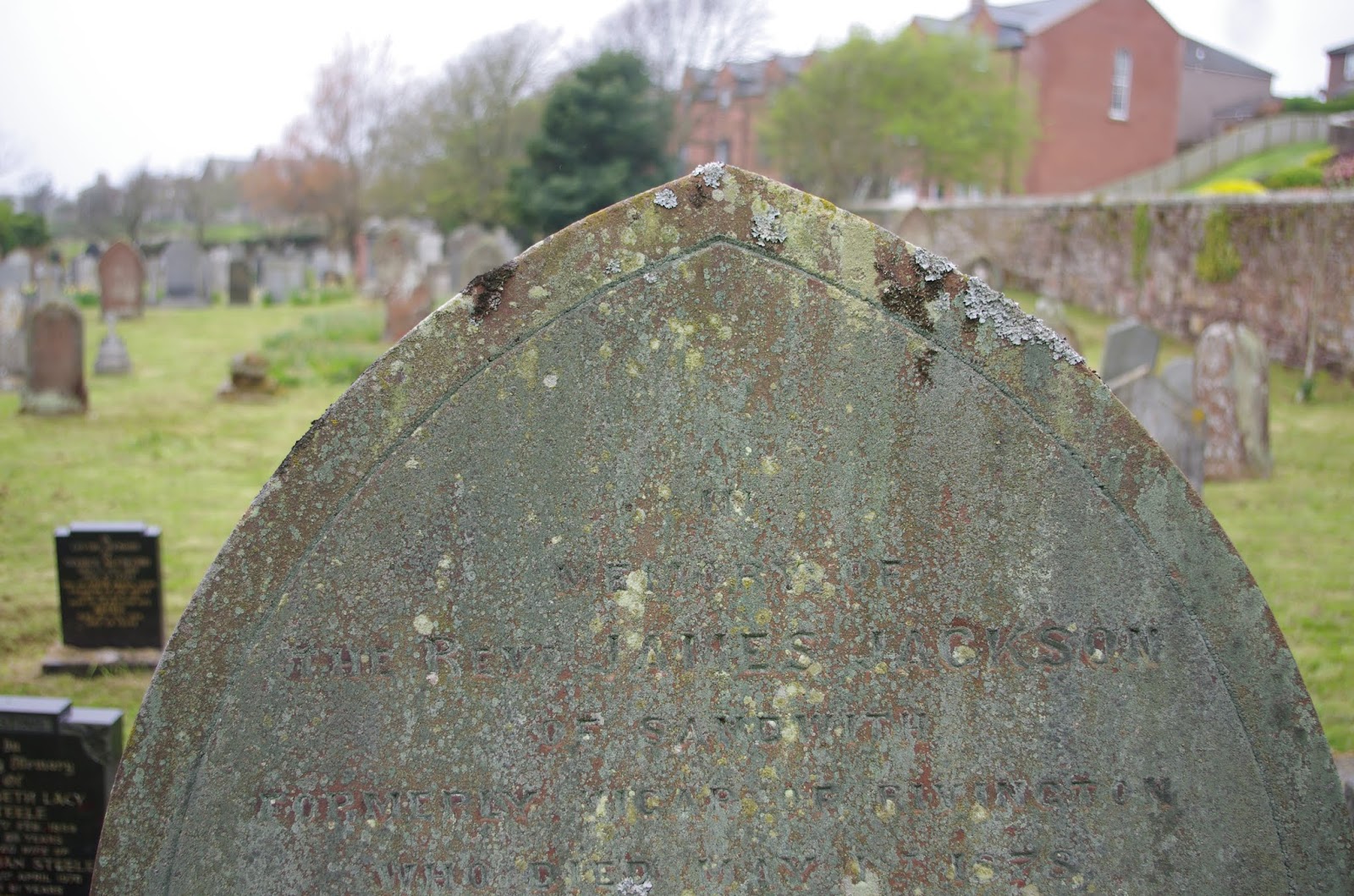
The Grave


A close-up of his name on the headstone.
A couple of years after his death two veteran mountaineers, Mr. F. H. Bowring and Mr. J. Maitland, both contemporaries of the Patriarch, built a cairn and placed an iron cross on the spot where the Reverend Jackson had been found, but the winter storms carried both away. On August 16th, 1906, a more lasting memorial was completed. Another veteran, Mr. C. A. 0. Baumgartner, the oldest living Pillarite, having ascended the Rock so far back as 1850 in conjunction with Mr. J. W. Robinson and Mr. Seatree, had the initials "J. J." and the date " 1878" chiselled on to the nearest suitable rock to where the body was found, by Mr. (George) Benson Walker, marble mason, Cockermouth. Taking advantage of the day set apart by Mr. Robinson, (of Robinson's cairn fame) one of Cumberland's foremost cragsmen, for his hundredth ascent of the Pillar Rock, an opportunity was found to have the work done. Mr. Robinson, Mr. Walker, and Mr. Seatree were accompanied by Mrs. Robinson, Miss Cleeve, Tasmania, and Miss A. E. Seatree. Mr. Walker found the rock to be very hard, but in a few hours an effective memorial of the old clergyman was inscribed which nothing short of an earthquake should destroy.
An earthquake certainly has not destroyed the memorial, but the coupled effect of time and weather has etched into the numbers and initials, making them all but indistinct from the rough rock face. The cross that accompanies the lettering is still clear to see and the one’s fingers can read the letters, that the eye can hardly see.

The cross to Reverend James Jackson. Hollydog applying some perspective.

The Cross in close-up
I knew he had fallen in Great Doup, but after four searches I was still unable to locate the inscription. Through a former work colleague, who is also a Mountain Rescue team member, he was able to ask some fellow climbers. Steve Reid, the owner of Needle Sports at Keswick, was able to assist, and I thank him greatly for that help. He had located this elusive memorial and manged to pass me greater detail on its location.  A further visit finally located the writing, along with the cross. Crosses are carved in the landscape to commemorate the passing of a notable human being and this deserves to be known further afield, especially after 141 years.


Postscript: On his death Reverend Jackson left effects to the value of £10,000 in his probate, with the executors of his will being his daughter Agnes, and his niece Elizabeth Jackson. His wife Susannah died on 25th January 1883, aged 66 years. Both she and Agnes are buried in the same grave. Agnes had married a William Pettigrew (who was 20 years younger than her and an Irish born farmer's son) in 1885 and died a widow on 21st February 1905, leaving effects of the value £1,464 16s 5d, to Miss Ellen Berry and Ernest Lamb, who was a draper.


******************


**I have previously published this account, and other new material, for public knowledge. I did so in the expectation that anyone wishing to further expand that public knowledge would do so by highlighting this original account, and then adding new information they discover themselves, as I have above. Sadly I am aware of one site that has repeated a large section of an account of another all but forgotten lakeland memorial to two boys that drowned and making out it was new, despite his following my many new lakes history accounts. I was asked by a person writing a book for Wasdale MRT for the generation of funds to assist that worthy cause. I gladly agreed to its use and he stated he would reference my original account. Such a stance by the latter is an honourable one; I hope the former person reflects on his conduct and no longer copies my work and then makes out he has found a new lakes history; that is dishonourable and diminishes him.**


(C)opyright

For further reading on the letters, this is the link. It may only be of interest to climbers or lakes historians: 
https://scafellhike.blogspot.com/2019/06/a-series-of-letters-by-reverend-to.html


Tuesday, 17 February 2015

The Scafell tragedy of 1903 Broadrick, Jupp, Garrett, and Ridsdale.

Like myself, walkers of the Lakeland fells begin out of a desire for fresh air, peace from the routine and pressures of work, pure exercise and not least, to test oneself in the face of nature. It is not really a sense of the history of a place or area that initially drives you to walk the fells or climb the rock faces, yet you cannot do so without beginning to gain some knowledge of the events that shaped the landscape and the people who worked the land, or enjoyed their own quest for adventure. Some events are known only to local people and a select few, yet others are known by a much broader audience.
One such event was the tragedy of 21 September 1903 when four ground breaking climbers, R. W. Broadrick, H. L. Jupp, A. E. W. Garrett and S. Ridsdale, set out to climb the rock faces of Scafell which tragically ended in the death of all four climbers. It is not my intention to enter into any great detail the reasons why this came about, many other sites go into this and I am a walker not a climber. 
The brief circumstances are they met another party of climbers near Lord's Rake and departed from them at around 2.30pm, each party doing separate climbs. The other party returned back along the rake at around 5.40pm and found all four climbers roped together at the foot of the rock-face, Broadrick, Jupp and Garrett were already dead. Ridsdale, although seriously injured was imploring the others to look after his colleagues, unaware they were dead. One of the other parties raced for help and on returning at around 8.30pm they managed to get Ridsdale down to the valley by 03.30am. They reached the valley floor and Ridsdale was still alive, yet by the time they got to the Wasdale Hotel he had passed away. That is a time span of nearly 10 hours between knowledge of the incident to recovery of the injured party and that is only to the valley floor.
 From my experience, in today's modern age, from discovery a winch helicopter would be on the scene within 45 minutes and the injured would be at Hensingham Hospital (Whitehaven) within 10 minutes of scene evacuation, or 15 minutes to Carlisle, or 40 minutes to Newcastle for more specialist accident treatment. How times change
The other bodies were recovered the following day and the inquest held on 23 September (a modern inquest would be at least one year, if not approaching two).


Wasdale Head with Great Gable at it's head, St. Olaf's church in the foreground trees.


Many walkers search out the cross while at the base of Lord's Rake, knowing of this iconic monument, mentioned in many reports on the internet and books. There are also references and images of the Grave within St Olaf's Church near the valley head.

St Olaf's Church, Wasdale Head (note the shadow of the entrance gate off the lane).

Above is the church with the first grave being the one containing three of the climbers who fell. It was a tradition to be buried where one fell, not unlike The Alps, Himalayas or war graves.

The grave


Inscription
IN LOVING MEMORY OF
 HENRY L. JUPP SECOND SON OF
CHARLES JUPP OF CROYDON
AGED 29
ALSO OF ALGERNON E. W. GARRETT
ONLY SON OF THE LATE
COMMANDER E. GARRETT R. N.
(OF DEVONSHIRE) AGED 27
ALSO OF STANLEY RIDSDALE
SECOND SON OF
ALFRED RIDSDALE OF KEW GARDENS
AGED 26.
WHO LOST THEIR LIVES ON SCAWFELL
SEPT. 21ST 1903.
"ONE MOMENT STOOD THEY AS THE ANGELS STAND
HIGH IN THE STAINLESS IMMINENCE OF AIR
THE NEXT THEY WERE NOT, TO THEIR
FATHERLAND TRANSLATED UNAWARE"


The above grave quotation is the second verse of a poem titled,'On a Grave at Grindelwald', by Frederic William Henry Myers (1843–1901). The full poem is (with plural replacing singular): 

HERE let us leave him; for his shroud the snow,
  For funeral lamps he has the planets seven,
For a great sign the icy stair shall go
  Between the heights to heaven.
 
One moment stood he as the angels stand,
  High in the stainless eminence of air;
The next, he was not, to his fatherland
  Translated unaware.

The rock face before the Lord's Rake ascent going to the right (difficult to make out but the cross is at the end of my dogs tail
The cross inscribed into the rock face
The carved initials to the right of the cross

Lord's Rake route is an inevitable and famous route onto this second highest fell in England. Many of those walkers are aware of the tragedy from literature on the internet or guide books bought on Lakeland walking routes. Those that are inevitably look for the cross at the base of the rake, carved into the rock face in tribute to the four fallen climbers who lost their lives on that fateful day.

Lord's Rake
I decided to post this account as one part of the event is largely unknown. As stated above, the incident, memorial cross at the base of Lord's Rake and the grave in Wasdale are all well known, to greater or lesser degrees. The one article missing from the story is that of Broadrick. He was an individual from Windermere and the family had his body returned for burial there. The only information I can find referring to his burial site is a local newspaper recognising the centenary in 2003, yet any commemoration appears to have only been held at Wasdale.


St Mary's church, Windermere.


Richard W. Broadrick's Grave

The grave inscription

The Broadrick family graves, R. W. Broadrick is the second right.

It seemed an appropriate tribute to have at least one site on the internet where all four climbers can be commemorated next to each other, albeit in photographs on an internet page. They died together, let them at least (albeit visually) Rest In Peace together, finally.

*******************


**I have previously published this account, and other new material, for public knowledge. I did so in the expectation that anyone wishing to further expand that public knowledge would do so by highlighting this original account, and then adding new information they discover themselves. Sadly I am aware of one site that has repeated a large section of an account of another all but forgotten lakeland memorial to two boys that drowned and making out it was new, despite his following my many new lakes history accounts. I was asked by a person writing a book for Wasdale MRT for the generation of funds to assist that worthy cause. I gladly agreed to its use and he stated he would reference my original account. Such a stance by the latter is an honourable one; I hope the former person reflects on his conduct and no longer copies my work and then makes out he has found a new lakes history; that is dishonourable and diminishes him.**


(C)opyright


Sunday, 17 February 2013

Crag Fell, Grike & Lank Rigg, Ennerdale.

Thursday 31st January saw three of us in the Ennerdale area of The Lakes. One of the party had never been on the Grike range to the west of Ennerdale. This was my second visit this year and I was interested in changing our previous route slightly to take account of the path on the far shore of Ennerdale Water, a path I had not previously walked. We parked on the Bleach Green Cottage car park, on the south side of The River Ehen and headed past the cottage toward the foot of the fell taking the track that veers to the right of Crag Farm House, heading for the gate.


Setting off.
 
 
The weather was not as good as the forecast had indicated, or we were being too optimistic, however it didn't appear to be about to rain anytime soon, though it was cold. The clouds were off the fell tops so it was to be a walk where we could navigate by sight.
Once through the gate we aimed slightly to the right and picked out the worn track (not marked on a map, but very distinctive) that goes directly up and connects with the footpath through the wood which then goes over Ben Gill by the waterfall. Our first destination was to be Crag Fell, with the intention of heading to Grike, then dropping off the back to Lank Rigg.
 

The view over Ennerdale Water and the weir with Bowness Knott and Great Borne on the far shore.


Striding out for Crag Fell.
 
The snow was just clinging to sheltered areas of the fells and these are all rolling fells with no crag faces to encounter so we expected no safety issues, we all carried trail spikes and I had an ice axe for overkill. Both dogs were loving this outing being grass to run about on and soft on the paw. The summit of this fell is never quite in sight until you are just about on it, but the near top is in view whereupon it flattens to a gradual and easily manageable incline, so it was 'heads down and crack on' time.
 
 
Crag Fell Summit
 
None of these three fells rate in the most dramatic fell category of lakeland peaks, though you do get the contrast of the fells and the solway plain that skirts between the coastline and the National park. They also afford you views across to Galloway and to the Isle of Man when the views are clearer, though not today unfortunately. Being a west cumbrian I was not here to glimpse these, having had a lifetime of looking at them, though I am struck by how others take time to soak in what I have taken for granted all my life. What I personally enjoy from these vantages, is the different aspects looking to the Buttermere ranges and to Pillar. Ennerdale is a much more secluded valley than say Langdale or Borrowdale, the only longer drive for most walkers and tourists is to Wastwater yet this draws people for the iconic Scafell Pike and the dramatic screes. Ennerdale has no single iconic feature, even Pillar is a long access from here and people tend to travel to Wastwater to scale this group, yet Ennerdale's remoteness is it's joy, away from the crowds with many features of interest not least the ancient settlements between Latterbarrow and Starling Dodd. These were not on our itinerary today though and our next destination was Grike.
 This fell is a small drop off and gradual climb up to the summit, having two cairns near it's summit. The views are much the same as from Crag Fell, except you see less of the lake and more of the plain toward the coast below St. Bees Head, the closest point in England to Ireland.
 
 
Heading for Grike.
 
We had devised a plan here to go 'off path' and head to the wood with the intention of making a more direct route up to Lank Rigg. On the last walk we had gone through the larch plantation, which was hard work, but on looking back the plantation had been cut down to the west and we had not been far from it. We took this more open approach to Whoap Beck and headed directly up Lank Rigg. This was a slog, but was to be the last real climb of the day, so again, heads down, hang on to the shirttails of the one in front and try not to get blown out the back of the group.
 
 
Lank Rigg Trig point summit.
 
Once on the summit we took time to address any clothing issues and we were to have our bait here so I donned an outer jacket for warmth while stationary. We dropped toward the back of the fell slightly to get some shelter from the wind. Although not harsh, it was a cold day and the wind enhanced it's bite. We skipped the lower cairn top to the west which normally affords views of Sellafield and the plain to Ravenglass as it was hidden by descended cloud. We had our food, got loaded up with tea and coffee, took in the views of Caw Fell and Pillar, but now it was time to start thinking of our second refreshment stop, The Fox and Hounds back at Ennerdale Bridge. ( Well, you didn't think the walk was about three Wainwrights did you?)
 We headed to the summit of Whoap and then took the gate through the wall and skirted Boathow Crag and followed the stone wall line which is to the right of Red Beck, going down to Ennerdale Water. Although steep, it was safe, even on the higher frozen ground. Once at the valley floor we headed on the path back to the weir that raised the level of Ennerdale.
 
 
Heading to the Red Beck wall, in the valley bottom is Bowness Knott, in the distance is Knock Murton.

 
The lake path with Anglers Crag ahead.

 
Looking back up Ennerdale Valley from below Anglers Crag.
 
This was the part of the walk that had interested me. I have not done this path before and loved it's views. As a lake shore path it is not a gentle stroll, being rocky in places and a steep scree drop to the lake at some points on it's route. We skirted round Anglers Crag and although these fells are rounded this crag face is steep, dramatic to view and you don't get a sense of it from the usual Bowness Knott side of the lake.
 We could have skirted the fell bottom but I wanted to take the weir path, again I've seen this from a distance but never actually been to it. En route to this we came across a tribute seat to:-
 
 
Ian Forsyth and Prince
Lake District Search and Rescue Dogs
Association
 
Two bunches of flowers had laid laid at this fitting tribute to these two worthy members of an association that will give it's time freely to search and rescue 'fell users' when in need, yet a search of the Internet reveals nothing of this memorial. I would be interested if anyone has any information on this tribute.
 Soon we were at the weir itself and a final look back on Ennerdale Water before a half a kilometre walk to the car.
 
 
Ennerdale Water weir, Anglers Crag(right), Bowness Knott(left)


Journey's end and a quick change out of our fell clothing at the car, followed by a short car journey to Ennerdale Bridge and The Fox and Hounds. This is another gem of this valley with a variety of beers, mainly local with an added twist of travel miles marked on the pumps. Some of the beers were from Ennerdale brewery, 2.3travel miles away, even the Loweswater Gold was 35travel miles, though it is no longer produced at Loweswater in the next valley. Either way the Ennerdale Gold and the Loweswater Gold couldn't be faulted. With a good roaring fire and quality beers to warm up three retired(old) men it was a perfect end to a cold 12.5km, 850m ascent, brilliant short day's walking.