Wednesday, 25 September 2019

Maryport Lifeboat, the Henry Nixon 1865 to 1886.

The Henry Nixon (or Nixson) Lifeboat.
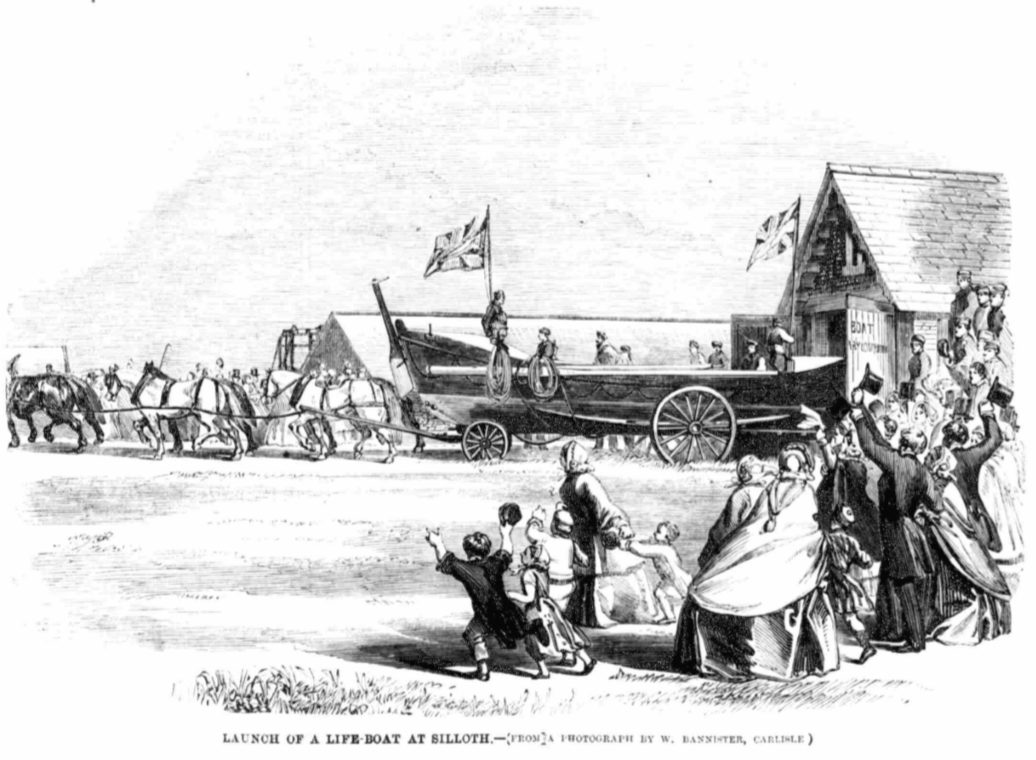
Whitehaven had a lifeboat, which was owned by the harbour authorities and had been placed there from 4th January 1804. It would be some time before the next boat would be placed on the North Cumbrian Coast. This the Angela Hannah, which was at Silloth and launched on 25th June 1860. Maryport was a busy port of both commerce and fishing and following an increasing number of sinking tragedies, and beaching of boats in storms, it was deemed essential to obtain a lifeboat for the town's harbour. The driving force behind this need had been Mr. Lindsay, the H.M. Collector of Customs Taxes for the port. Following his exertions, by early January 1865 the Royal National Life-boat Institution had agreed to make the port a life-boat station, on the understanding that a proper boathouse was built and a crew found, all of which had to be paid and maintained. A committee was immediately formed with Mr. Lindsay in the chair, the initial purpose being to raise £100 towards those ends. 
By February 1865, concerts were beginning to be conducted in the West Cumbrian area with that goal in mind. The public's consciousness on the subject was enhanced through the local newspapers, stretching from Carlisle to Whitehaven. The Carlisle Journal of 17th February carried the following poetical article on the subject.


A meeting of 25th May was for the purpose of the erection of a boathouse, the cost of which was expected to reach £600, and the construction of a gangway/slipway for its launch was also broached, although this appears not to have been built until the replacement of the Henry Nixon, by the Civil Service No. 5 lifeboat in 1886. The land on which the boathouse would be constructed was donated by Mr. and Mrs. Senhouse.
A Mr. Henry Nixson/Nixon,of Green Bank, Old Trafford, Manchester, came forward as a philanthropic benefactor and paid for the boat itself, with a total donation of £550.
The boat was built by Messrs. Forrestt and son, of Limehouse, London, who were established lifeboat builders, and had earlier built the Silloth boat. It was 32 feet long, 7 feet wide, with 10 oars, double banked. The carriage was built by Mr. Robinson of London, who had also built the Silloth carriage. They were shipped free of charge to the town by both the London and North Western, and the Maryport and Carlisle railway companies, both wishing to show their support for the men and vessel when saving life at sea.

Thursday 13th July was the day of the launch and a regatta was organised, with cheap trains being run to allow crowds to flock to the town for this momentous occasion. This event would go to define the desire for safety of those who went to the sea for a living, or who used boats a means of transport to other ports. At just after 12 noon the boat was loaded onto its own carriage at the railway station with the crew sat in the vessel in full lifeboat attire, and wearing cork jackets. It was drawn through the principal streets by four horses, headed by a large group of dignitaries, including the benefactor Mr. Nixon; and a band. A large procession of the public followed the lifeboat as it wound its way to the south side of the harbour, for the launch. Just prior to 1:30 pm Mr. Nixon made a short address, followed by prayers from Reverend J. Stevens. The 'christening' ceremony was conducted by Miss Deane, a relative of Mr. Nixon. She smashed the customary bottle of wine against the hull as the boat, which she christened The Henry Nixon, glided into the waters where it would in times to come, fulfill its life saving purpose. It was a self righting vessel, with patented valves that could self eject any water within 25 seconds, following its righting.
By the time of its launch their were now 150 such vessels stationed around the coastline of the nation. Later a dinner was provided at the home of Mr. J. P. Senhouse. The Chairman stated that Mr. Nixon had proved to be a friend to the town and toasted his health. Mr. Nixon graciously accepted the toast, adding he hoped the boat would show its qualities in the times ahead. Unfortunately, due to the boisterous weather, the regatta had to be scaled down as a number of boats were unable to weather the conditions.
Following a meeting of the Royal National Lifeboat Institution on 3rd August 1865 and the awarding of rewards to crew members around the country following the brave conduct, it was then stated that 3 new vessels had been built by Messrs Forrestt and Son for the French Shipwreck Society, superintended by the Institution itself. It also played host to Count de Baslard and Captain Albert, of the French Imperial Navy, who were present on behalf of the French Society to witness the system of management of lifeboat stations and the rocket systems. Great Britain were the forerunners in the lifeboat movement and led the world in the number of boats, and the technology of their construction and use.
In the course of the next year the Institution had dispatched another 37 lifeboats to the coastal towns, although some would be replacements for older, smaller and less safe boats, as the number had now increased to 160.

The first test if the life boat came on Tuesday 24th April the following year when the Goole Schooner The Treaty, was seen 8 miles E.N.E. of the town at Dub Mill Scar, between Allonby and Mawbray, and was flying a flag of distress. It was laden with a cargo of granite.  There was a strong W.S.W. gale blowing at the time and the lifeboat set out under canvas to assist, taking an hour to arrive. It dropped its anchor near the vessel which was crewed by a master and his wife, and two other men. The master was ignorant of his whereabouts so the coxswain and four of the lifeboat crew boarded the vessel. One of the crew was in the rigging, and the sea was breaching the vessel. One of the cables then broke, so the coxswain quickly shipped the other and ran the schooner into Silloth harbour, thus saving both life and vessel. A steam-tug had by this time come out and then took the lifeboat back to Maryport harbour. It was said by the crew that their new boat had performed admirably in the adverse conditions, they being very pleased by its handling. This brave performance of the crew resulted in a £6 reward being paid to them following a meeting of the Institution on Thursday 3rd May.
At 7 pm on Sunday 7th February 1869 a terrible S.S.W. gale was blowing when a brig was seen in distress, north of Maryport harbour, with its anchors down and its masts cut away. Within 20 minutes a number of rocket lines and the whip block and tackle were fired over the ship but the crew were unable to attach the equipment to effect an escape. The ship was the Robert Bruce, of Belfast, and the lifeboat was launched and managed to get a grapnel to her, but the jerk of the waves straightened it. A 2nd attempt was made but the rope snapped, however, a 3rd attempt managed to secure the line and get the six crew off before it finally broke up.
The 17th December 1871 saw the coal laden brig The Wanderer set sail from Maryport harbour, heading for Derry. Due to the adverse weather she had to try and return to the port on the afternoon of 18th, but passed the harbour and was driven onto the shore. The lifeboat was once again launched and saved the 10 crew.
In May 1875 the boat was launched to aid the crew of a smack called Native, of Piel which had gone ashore on the North Bank. The vessel was extricated from its perilous position and the crew of three were safely taken into the harbour.
Thursday 10th October 1878 saw an iron barque, the Carn Tual, of Liverpool, trying to ride a gale with its anchors down, between Robin Rigg and Dumroof Banks. It showed signals of distress so the Henry Nixon lifeboat was launched. It spent 6 hours searching for the vessel but nothing was found and she returned to port. The next day she put to sea again, towed by a steamer, and found the vessel, saving all 9 crew. The Carn Tual was still afloat and was later towed to Whitehaven harbour.
The morning of Friday 17th October 1879 saw the lifeboat called out by telegram to assist a barque flying signals of distress that was half a mile out, and off the slag heap at Workington. It was at anchor, riding out a storm and was in difficulties. It was the Solafide of Grimstadt, Norway and was bound from New York to Maryport via Queenstown, with a cargo of Indian Corn for Messrs. Rigg and Co.. The vessel got into difficulties at 4am and had made every effort to keep from beaching, but by 7am the captain finally had his wife, the ships mate, and three crew sent off in the ship's rowing boat to get assistance. The lifeboat was dispatched to save the rest of the crew if the situation worsened, but finally the wind dropped and allowed the Workington tug The Confidence, to finally put to sea with the mate and crew members of the Solafide. They managed to re-board their vessel and after a number of attempts to fix a line, they finally were under tow and taken into Lonsdale Dock.
Perhaps the most dangerous rescue the lifeboat was ever involved in was that of the morning of Monday 12th February 1883. The Cumbrian coast was subjected to the worst storm in the memory of some of the oldest residents of the area. The Diana of Belfast appeared off the port and was flying signals of distress. It overshot the harbour and bounced along the beach before turning broadside to the waves with their full force then crashing over the ship. The Diana's crew had tried to take to their life craft but to no avail. The Henry Nixon lifeboat was launched to cheers of the thousands now watching the dangerous, yet amazing spectacle. It was crews by Robert Avery(Coxwain), John Benn (second Coxwain), Joseph Hoffin, Thomas McParthen, William Kirkbride jun., John McGuire, Thomas Fisher, S. M'Grae, William M'Gee, Joseph Donaldson, William Porter, John Hodgson and Patsy Reed. It was seen cutting through the waves, at times lost in the troughs, then riding the huge crests. It made it to the stricken Diana but as the Henry Dixon rounded her stern, Hoffin, M'Grae, Donaldson, and Porter, were tossed out into the raging sea. Ropes were thrown and the first three regained the safety of the lifeboat, minus their oars, but Porter missed his line and drifted too far from the boat. On land three man now played a hand. James Ogle, a Customs House Official, and Two Naval Reserve men called Matthew Purcell and John Byers now threw there coats to one side and entered the crashing waves to try and rescue the stricken Porter. The strongest swimmer was Byers and he shot ahead of the other two, reaching Porter as his strength began to fail him. They manged to get Porter to the shore, with tremendous cheers then coming from the huge crowd; Porter was saved. The lifeboat crew had tried to rescue him but themselves struck the bottom on a number of occasions, before managing to get back into deeper water. Now he was rescued they turned their attention back to the task in hand but found the water now too shallow between the  Diana and the shore to effect a rescue. The steam tug Florence now attended but had to lay by, due to the shallow waters. A party of naval men tried to launch a boat from  the shore but it overturned on them all. Around twenty men then rushed to their aid, managing to recover them all from under their vessel. Finally a rope was fired across the Diana and slowly the crew were rescued by this means. The Diana was 200 tons burthen, owned by Mr. Moore of Portaferry, and was believed to be a total wreck. On the previous Thursday the schooner The Just had to beach at Allonby and the Florence also had to take a trawling smack in tow, into the safety if the harbour.
On Wednesday 23rd January 1884 another storm lashed the coast and a Norwegian barque called The Alma was anchored two miles off Maryport harbour. This vessel was formerly a Russian man-of-war. The lifeboat crew were called following a distress signal at 5pm, and kept vigil from the piers until 10 o'clock when the Alma crew now wished to be rescued. The lifeboat was towed out by the steam-tug Florence. Despite the darkness the whole crew of 12 were safely brought to the harbour at midnight without mishap. The weather moderated on Thursday and the crew were able to be returned to The Alma, which had by now suffered great storm damage to its mast and rigging; it was also shipping water. The captain had said that it had been impossible to remain on the ship in the storm as the waves were crashing over her fore and aft. The crew of the Alma presented coxwain Robert Harvey with a fine model of a barque, a valuable album and a powerful telescope. He had boarded the vessel and navigated it to the harbour entrance.

In early December 1886 this essential vessel for Maryport had become obsolete as bigger and technologically more up to date vessels were constructed. It was replaced by 'The Civil Service Number 5', which was christened in a ceremony on Thursday 2nd December. This vessel would now conduct rescues around the harbour of Maryport. The Henry Nixon had been attributed with the saving of 54 souls from drowning in the Solway Firth, a roll of honour to be rightly proud of. It had done so in the most dangerous of conditions, with no loss of life to any of its crew, despite the dangers they had faced. Rather ignominiously the Henry Nixon was sent to London to be broken up; a sad end for a vessel that had performed a high duty to the town, residents, and wayfarers of the coastal waters. During her service a total of four coxswains had commanded her missions of mercy. They were: George Rule, John Webster, Robert Harvery, and finally John Benn.


(C)opyright.


Saturday, 21 September 2019

The First Sillloth Lifeboat, The Angela Hannah, 1860 to 1867


The Solway Firth like many other coastal areas, was a dangerous location for shipping, particularly as storms lashed the Cumbrian coastline. Men made their living from the shipping of goods to and from its ports and the fish the sea had to provide. Both had a cost, paid for dearly with human life. The ships that made for the Cumbrian ports of Whitehaven, Workington, Maryport, Silloth and Port Carlisle were vulnerable to these elements of wind and tide, with the coastal rocks and shallow sand banks in the Firth itself, hidden just below the tidal surface. In 1859 there was already a lifeboat stationed at Whitehaven but no others, despite the many deaths that occurred along the coastline, or making their way to or from those harbours. On Monday 29th August 1859 a ship called The Amelia was coming out of Port Carlisle and had to run aground near Silloth as it was blown off course by the storm. The next day The Mary was making its way to Port Carlisle, in similar storm  conditions, and was laden with slates. It became grounded on Silloth Bank at 10:15am and the crew flew signals of distress, then having to take to the rigging as she began to fill with water. The Queen was bound for Dumfries and after repeated attempts at rescue, she finally managed to save the crew of the stricken vessel, but the Mary's mast now snapped and seriously injured the mate of the Queen. Thankfully there was no loss of life but these incidents now caused discussions to be had on the need for the positioning of a lifeboat at Silloth, as Whitehaven was too great a distance to effect urgent rescue.
By mid October that year the Royal Lifeboat Association had decided to place a vessel there, but the funds for the boathouse, carriage, and the lifeboat itself had to be gathered by subscriptions or donations. These were proving difficult to gather, until a female philanthropist called Miss Angela Georgina Burdett Coutts, of 22 Regents Park Terrace, London, offered to pay for the lifeboat, if local funds could be found for the carriage and boathouse. 
The boat was built by Messrs Forrestt of London and was put through a harbour test at Limehouse, in the city. It was 20 feet long, 7 feet wide, 3 feet 3 inches deep, was rowed with eight oars and weighed 30 cwt. The carriage was built by Mr. Robinson, of Cambden Town, London. The boathouse had already been constructed and the boat and carriage were transported free of charge by the London and North Western Railway Company. The boat was launched to great fanfare on the afternoon of Monday 25th June 1860, near the Cote Lighthouse on the Skinburness Road. As it launched from the carriage into the water, Mr. William Gaddes, the inspector of buoys and light houses in the Solway, dashed a bottle of port against her side. It was crewed by: John Duff (Coxswain), Robert Ferguson, William Hawkins, Thomas Howes, Jos. Bennett, Joseph Faulder, John Johnston, and James Matthews. All were men of the neighbourhood.


The AGM for thre lifeboat took place on Tuesday 19th March at Carlisle Town Hall with the Mayor Mr. J. D. Carr in the chair. The finances were gone over and the cost of the life boat was stated as £148 9s 6d, the boathouse £146 18s, the carriage and skidds £59 and the stores were £30.
September 1861 saw the addition of a patented coast barometer, calibrated against the Greenwich instrument. Fourteen of these had been in operation along the Northumbrian coast, paid for by the Duke of Northumberland, and were believed to have been instrumental in the saving of more than 30 lives.
Quarterly exercises were performed, testing the boat and training the crew. The one conducted on 6th October 1862 was done so under the most trying of circumstances. A strong gale was blowing with a heavy sea rolling in on a low tide. One man was thrown from the boat but fortunately received no injury, but it highlighted the risk the crew were exposing themselves to in order to save life from the waters of the Solway.
The boat provided service to the town and local communities for a number of years, but by 1867 it was regarded as no longer fit for purpose. It was then replaced by a mahogany built boat, 32 feet in length, now with 10 oars with the name of the new boat to continue with 'Angela Hannah'.


(C)opyright


Tuesday, 17 September 2019

The Sinking of the Briton at Maryport Harbour, on 13th February,1882


The Briton was a brig, which is a two masted square rigged ship, and was built at Maryport in the yards of John Peat & Company. It was a fine coppered and copper fastened vessel of 111 tons burthen per register, its name was depicted by a full length carved figure of an ancient Briton with spear and buckler. It was built for Captain Mason of Seaton and was intended for the St. Domingo trade. 
 In 1846, following repair, she was then put up for auction on 13th April at Mrs. Rennick's Senhouse Arms Inn, at Maryport. The boat was described as 'ready for sea' at the time of auction, the auctioneer was George Lister. 
 She was once again put up for early auction on 26th January 1847 at The Golden Fleece, Whitehaven. The vessel was now mastered by J.W.T. Middleton, and advertised as fully coppered and repaired at Whitehaven, in September last. However, it was listed, still under the deposition of Joseph W. J. Middleton, in Lloyd's on 16th December that year as sailing from Newport for Dublin. 
She was again to be auctioned on 30th August 1859 at Whitehaven and it was adverted that she was in 1st class order and £1,200 had been spent on her. Through her life she would undergo many auctions of the ship itself, or shares of her.
In January 1866 an application to remit a portion of the dues owed was made by the then owner, Mr. Thomas Kelly of Whitehaven, who had lost a man overboard at St. Bees Head on the night of 30th December. The Briton had then missed Whitehaven, but got into Maryport harbour. The trustees agreed to so remit part of the dues, as it had neither discharged nor taken on a cargo at its intended harbour.
 In February 1882 she was now found to be registered at Kirkcubbin, of Strangford Lough, Ireland, and commanded by J. M'Kay. 

Sunday 12th February was one of the finest and mildest winter days ever known in Maryport, but this turned into a tremendous storm through the night. On the morning of Monday 13th it was reported that a West to South West wind of Force nine was billowing and it was raining, with very limited vision. Some described it as a hurricane force wind; waves were breaking over the pier, with slates and chimneys being blown off roofs. 
At 4 am, Harbour boatman Wilson Beck went down to the south pier to light the tidal light; this would signal to shipping that there was 8 feet of water to enter the harbour in, the tide then being 4 hours flood. He saw two bright lights at sea, a little to the west of Flimby. It was later known to be The John, and the captain was signalling for a tug. Wilson alerted John Brown, the mate of the 117 tons gross weight, iron steam-tug called the Florence, who informed its commander, Captain Mounsey. This vessel was owned by The Maryport Steam Shipping Company Limited, and it then set out from the harbour to offer assistance. As they passed down the harbour channel, driven by the 70 horsepower engines, they came abreast of the light and stopped the engines, so not to proceed into the huge waves at too great a speed. Suddenly they spied a topsail, then a vessel, coming into the harbour. Mounsey shouted an urgent command of, 'Full speed astern!' to his engineer, although the helm wasn't altered. He then called out to the vessel, 'Hard a Starboard!' The  two ships soon collided with the Florence struck on the starboard bow and her mast was carried away. The other vessel was The Briton, and it then drifted damaged down the channel, going ashore on the north bank of the harbour and immediately broke up on the rocks. The crew of three and the captain took to the rigging in an attempt to save their lives. 
Following the collision the Florence captain had instructed the engineer to 'Turn a-head' with the intention of proceeding to the original vessel, the John, that had signalled for assistance. Unfortunately the mast and its stays had become entangled in one of the paddle wheels and the steamer had to move a'stern and return to port to clear this.
The next vessel to try and make the harbour was The John at 4:45am, but she was blown onto the shore a quarter of a mile beyond the harbour and beached. At 5am the North Branch attempted the harbour entrance and missed, though managed to drop her anchor, and brought herself up at the end of the north pier. The Ottawa then attempted to enter after ten further minutes and also missed the entrance. She narrowly passed the North Branch and beached on the shore near the north pier. She was within 30 yards of the stricken Briton and saw her crew crying out for aid in the rigging, but could offer no help. The Briton crew were known to have hung to the rigging for an hour and a half before their strength failed them and they were lost to the crashing waves; all four men were drowned.
The next ship, called The Allies, later tried to make the safety of the harbour, but struck the North Pier and remained there until the following day. This ship and the Ottawa, both of Maryport, were eventually wrecked, although there was no loss of life from those two vessels. 
The inquest was opened at the police court on Wednesday 15th and Adam Palmer, the father-in-law of James Gaw gave evidence of identification. He also told the inquest that the brig had sailed the previous Sunday, 11th. 
James Wilson Ogle, an out-door officer of customs, was on the hill at 9 am and saw the ships beached. He went down and helped recover the first body, then another three. Two locals were able to board the stricken Briton at 11 am, and not before due to the danger. The eventual verdict on th efour bodies was 'Found Drowned' and the main inquiry into how the accident happened would be an issue for a later maritime inquiry. The bodies of four deceased crew were released after identification by the coroner and were placed in coffins for transport back to their native Ireland. The bodies were arranged to be transported by rail to Barrow for shipment, at £5 per coffin. Thus would have been a significant cost to the bereaved families but now the owner of the s.s. Black Diamond, crewed by naval reserve men, was telegraphed and agreed to transport the bodies free of charge. That departure was from Maryport as the ship was engaged in the transport of coal, and was sailing to Belfast. She was owned by Mr. Wood, the brother of John Wood, who owned the Maryport Hematite Iron Works, and was a Trustee for the town and harbour. The coffins were loaded for a 5pm sailing; the whole town turned out in reverential respect to fellow departed sailors. 
On Friday 17th, all four crew members were buried in their native graveyards. James Gaw (36), the owner and captain, was buried at Glastry; Francis Filston (35) in Kirkcubbin; James Ross (36) in Ballyhalbert; and John Dorrian (21) in Lisban graveyard. A subscription of £50 was raised for the widow and orphans of Filson and Ross.

Coastal towns live with tragedy at their door and soon recover. That a terrible shipwreck had occurred was undisputed, but hand in hand with coastal catastrophes and loss runs their bedfellow, namely salvage. The contents of the Briton were auctioned at the Custom House Yard, Maryport, on Monday 20th of that month. Following the contents auction the remains of the vessel itself were further put under the hammer. It had been clear from the later inspection of the wreck that the stern had suffered catastrophic damage.

A Board of Inquiry was commenced on Friday 24th March, to investigate the circumstances of the tragedy. It continued on 25th and concluded on 27th. It was held at the Athenaeum and chaired by Mr. Rotheray, the Chief Commissioner of Wrecks with The Board of Trade. The Maryport Steam Shipping Company, and the Briton owners were each legally represented. Two assessors were also appointed under 'The Shipping and Casualties Act, 1879'. They were Captains Murdoch, Parish, and Rear Admiral Moresby, RN. It was said the Briton was 68 feet long, 19 feet broad, and 10 feet deep. She had sailed from Portaferry on 12th and was laden with twenty tons of stone ballast, eleven and a half tons of potatoes and five of hay and bound for Whitehaven. James Gaw had owned her for a year and it was a seaworthy vessel and not overloaded. 
The Board immediately honed in on the weak points of those who tried to clear their actions. Captain Mounsey came in for the particular criticism of The Board who stated that The Briton was coming into the harbour quite properly.  The 'Hard a-Starboard' shout was a violation of the rules of the road at sea. Then after the collision there was no evidence to show that the crew of the steamer had tried to aid any of the crew of the Briton, despite the fouling of the starboard paddle wheel. The board concluded that something should have been able to be done to rescue the crew. They said that all Captain Mounsey did was return to the safety of the harbour. Although he reported to the harbour master that he had been in collision with another vessel, the seriousness of the impact was not conveyed. They further concluded that he had set about to treat the collision as lightly as possible. They then censured William Johnston, the acting harbour master and the John Webster the coxswain of the Maryport lifeboat, for not sending out the boat when they knew a vessel had been struck. They stated that the regulations of the lifeboat were disgraceful and clearly what occurred was, 'What is everyone's business is nobody's business'. It was said that the lifeboat would not be sent to a vessel unless they specifically signalled they were in distress. The board found such a statement as simply astounding on any level of human intelligence. How could a man, who had taken to the rigging of a broken vessel to save his life, send a signal of distress? The only signal that such crew could give was cries for help, and hope brave men would risk themselves in the face of such a tempest to save fellow sailors; that cry for aid was ignored. The final board decision was that Captain Mounsey was to blame for the collision, having tried to pass on the inside of, and the starboard side of The Briton. They further concluded that Webster and Johnston were to blame for the failure to launch the lifeboat. Mr. Hutchins was the Chief Coastguard officer, but they concluded he was blameless. He had only been alerted around 6:30 am and attended immediately. On going to the end of the north pier he saw what he believed was a man fluttering a flag and ordered the lifeboat to be launched, but before it could be got out the flag waver had disappeared.
The local press reported on the board of inquiry findings and used the words of, indifference, cowardice, and they commented also on the shame born by the town, due to the inaction of its harbour staff.

On Tuesday 23rd January 1883, at Whitehaven County Court the case of Ruth Gaw -v- Maryport Steam Shipping Company Limited was commenced at a preliminary hearing. Mrs. Gaw was claiming £300 for the loss of The Briton. A date was set for the full case and at Carlisle Court on Wednesday 9th May this was to be heard. The claim was now £279 and it was recognised by each party's barristers that Mrs. Gaw had a separate claim  for the loss of her husband, to be heard before the Admiralty Court in Liverpool. The lawyers had all now fairly met and agreed a settlement of the whole matter at £500.


(C)opyright


Tuesday, 10 September 2019

Charles Gough, The Faithful Dog, and the Helvellyn Monument


On Saturday 18th April 1805, Charles Gough, a painter from (Kendal/Manchester) was holidaying in the Lake District, reported to be with his brother, and had stayed at Thomas Dobson's Inn at Patterdale. It was a common occurrence for him to holiday in The Lakes, as he had for the previous three years. On this day he intended on setting out for Wythburn with the intention of fishing in that water, now extended from Wythburn Water and Leathes Water to become Thirlmere; this was a regular haunt for him. He was to travel over the Helvellyn range and would take his fishing tackle with him, accompanied by his trusty companion a small brown terrier called Foxie. After eating at the inn he enquired if a guide could escort him over the range yet there was a General Review Day of the Volunteers in Patterdale and no guide was available. He set off to make the journey with his only companion being his little rough haired terrier (one account calls it a spaniel) and was never heard of alive again.

Striding Edge, as seen from the Nethermost Pike path.

Helvellyn summit looking back to Glenridding, and Charles Gough's route

Striding Edge with the rise to the Gough Memorial stone, likely the area of his fall.

Coming off Striding Edge for the final summit climb, where Gough would have fallen

Looking back along 'The Edge'.
Accounts state that people tried to dissuade him from the unaccompanied journey, yet he endeavoured to reach his goal, but the weather turned. One account says it snowed that day and the mist descended over the fells.
The exact location of his body is now not certain, but for reasons later disclosed it seems most likely to be the final ascent to the summit from Striding Edge, on the southern side of Red Tarn, Helvellyn. On 20th July 1805 a shepherd boy was out on the fells and heard a dog yelping. When he went to investigate he came across the decomposed and flesh stripped body of a man. The body was in such a state of decomposition the the head was detached and lying seven yards below the main corpse. Some accounts give the hands and feet as being detached. The shepherd boy raised the alarm in Patterdale and a party of men set off to recover the deceased male. On reaching it they checked the body and confirmed who it was through an engraved gold watch and papers in his pocket book, it was indeed that of Charles Gough. The dog appeared to be in a very nourished condition and had clearly been in pup when they began the fateful journey on 18th April. The searchers discovered she had born a litter; two were now dead and lay next to Gough's body, but at least one other was still alive, appearing to be about six weeks of age. The adult bitch could not be taken hold of and was hunted (to capture) by the shepherds dogs and eventually taken to Patterdale Hall, with the one remaining pup. These were then taken on to Kendal by his maternal uncle, a Mr W. Braithwaite

Picture of the supposed scene, by Sir Edward Landseer, depicting the faithful Foxie never leaving her master.
Tragic as the circumstances were of the death, that Mr Gough came by his unfortunate accident on the slopes of Helvellyn, it was clear that he had likely fallen from Striding Edge area. The monument is set above the final face of the southern side of the bowl of Red Tarn. The accounts of the time though are confusing, some speaking of the Edge, some of Red Tarn Crags and others of Cat-stee, which we would now call Catstye Cam. The exact location is perhaps an irrelevance, the fishing tackle he had taken added to the tale in that it was found at the top(it was not stated whether this was the summit or top of either Edge), above him and part of the scalp was below this, stuck to a rock with a deep cut through his cap; he had clearly come to rest at a location some distance down the Red Tarn cliff-face following a fall from height. He may even have reached the summit ridge and become disorientated in the fog, perhaps a snow cornice had given way which to this day remains a hidden and real danger for the uneducated 'climbers' of Helvellyn.

Attention initially centred on the well nourished dog and it was speculated at the time that it had nourished itself by worrying the corpse of its Master. In one article it was reported:

 '....; for, it appears that a small brown bitch, which accompanied him, had pupped after the fatal event; which, together with her litter, were found near his remains, uncommonly fat, and the flesh of the latter was mostly consumed. ...'

 Local people quickly dispelled this as a likely version of events, stating that it would have maintained itself from carcasses of dead sheep that would be in the area and the worrying of the corpse would be from carrion that thrived in the area. Thus the scene was set for the romantic tale that led to two of the great poets of the time to write on the subject, Sir Walter Scott and Wordsworth.

Sir Walter Scott - Helvellyn

I climbed the dark brow of the mighty Helvellyn,
Lakes and mountains beneath me gleamed misty and wide;
All was still, save by fits, when the eagle was yelling, 
And starting around me the echoes replied.
On the right, Striden-edge round the Red-tarn was bending,
And Catchedicam its left verge was defending,
One huge, nameless rock in the front was ascending,
When I marked the sad spot where the wanderer had died.

Dark green was that spot 'mid the brown mountain heather,
Where the pilgrim of nature lay stretched in decay,
Like the corpse of an outcast abandoned to weather,
Till the mountain-winds wasted the tenantless clay.
Nor yet quite deserted, though lonely extended,
For, faithful in death, his mute favourite attended,
The much-loved remains of her master defended,
And chased the hill-fox and the raven away.

How long didst thou think that his silence was slumber?
When the wind waved his garment, how oft didst thou start?
How many long days and long weeks didst thou number,
Ere he faded before thee, the friend of thy heart?
And, oh! was it meet, that—no requiem read o'er him,
No mother to weep, and no friend to deplore him,
And thou, little guardian, alone stretched before him—
Unhonoured the pilgrim from life should depart?

When a prince to the fate of the peasant has yielded,
The tapestry waves dark round the dim-lighted hall;
With scutcheons of silver the coffin is shielded,
And pages stand mute by the canopied pall;
Through the courts, at deep midnight, the torches are gleaming;
In the proudly arched chapel the banners are beaming;
Far adown the long aisle sacred music is streaming,
Lamenting a chief of the people should fall.

But meeter for thee, gentle lover of nature,
To lay down thy head like the meek mountain lamb,
When, wildered, he drops from some cliff huge in stature,
And draws his last sob by the side of his dam.
And more stately thy couch by this desert lake lying,
Thy obsequies sung by the gray plover flying,
With but one faithful friend to witness thy dying

In the arms of Helvellyn and Catchedicam.

Wordsworth however did allude to the practical question of nourishment in his final verse of:

A barking sound the Shepherd hears,
A cry as of a Dog or Fox;
He halts, and searches with his eyes
Among the scatter'd rocks:
And now at distance can discern
A stirring in a brake of fern;
From which immediately leaps out
A Dog, and yelping runs about.

The Dog is not of mountain breed;
It's motions, too, are wild and shy; 
With something, as the Shepherd thinks,
Unusual in its' cry:
Nor is there any one in sight
All round, in Hollow or on Height;
Nor shout, nor whistle strikes his ear;
What is the Creature doing here?

It was a Cove, a huge Recess,
That keeps till June December's snow;
A lofty Precipice in front,
A silent Tarn [1] below! 
Far in the bosom of Helvellyn,
Remote from public Road or Dwelling,
Pathway, or cultivated land;
From trace of human foot or hand.

There, sometimes does a leaping Fish
Send through the Tarn a lonely chear;
The Crags repeat the Raven's croak,
In symphony austere;
Thither the Rainbow comes, the Cloud;
And Mists that spread the flying shroud; 
And Sun-beams; and the sounding blast,
That, if it could, would hurry past,
But that enormous Barrier binds it fast.

Not knowing what to think, a while
The Shepherd stood: then makes his way
Towards the Dog, o'er rocks and stones,
As quickly as he may;
Nor far had gone before he found
A human skeleton on the ground,
Sad sight! the Shepherd with a sigh 
Looks round, to learn the history.

From those abrupt and perilous rocks,
The Man had fallen, that place of fear!
At length upon the Shepherd's mind
It breaks, and all is clear:
He instantly recall'd the Name,
And who he was, and whence he came;
Remember'd, too, the very day
On which the Traveller pass'd this way.

But hear a wonder now, for sake 
Of which this mournful Tale I tell!
A lasting monument of words
This wonder merits well.
The Dog, which still was hovering nigh,
Repeating the same timid cry,
This Dog had been through three months' space
A Dweller in that savage place.

Yes, proof was plain that since the day
On which the Traveller thus had died
The Dog had watch'd about the spot, 
Or by his Master's side:
How nourish'd here through such long time
He knows, who gave that love sublime,
And gave that strength of feeling, great
Above all human estimate.

This however came out after Scott's more romantic version of 'Helvellyn' which turned Gough into a martyr of heroic 'seekers of the natural world'. Scott was the known celebrity figure of the time and Wordsworth was much lambasted by the critics of the age, only finding popular favour later in his life. I myself am of the view that the dog worried his master's corpse. This will always cause debate, especially from those who humanise such an animal to be human in its characters. All I can say is that I have experienced more modern incidents that, following death, such animals have quickly given weight to my view. I will say no more here on that point.
 Later, emanating from these great masters of literature, their followers in turn were to pay for a memorial to commemorate the death of Gough on the fell with the placing of this memorial stone in his name. These two people were Canon Hardwicke Drummond Rawnsley and the writer Frances P. Cobbe. It was erected by Messrs. Bromley of Keswick around November 1890.

The erection of the Memorial Stone to Charles Gough on Helvellyn. Hardwicke Drummond Rawnsley stands behind the stone, facing the camera.
The Gough Memorial now. (sorry about the muzzle!)

In an article from The Cumberland and Westmorland Herald of 1903 it was said that Rawnsley had been fortunate enough to have spoken to the son of the man who found Gough's body. His father had told him that he was up the fell the same day as he met Wordsworth, Scott and Davy. Scott was going down to see the very spot where Gough came to rest. His father took Scott down and Scott then sat on a 'girt stane, and just luikt, an' luikt, an' luikt'. Rawnsley himself became interested and went and found the stone and green area, which could not be seen from above. Scott himself was to descriptively refer to: 'The dark green in the brown mountain heather.' One would expect that now the location of the body coming to rest was identified to these academics, then this would in turn be passed on, until Rawnsley was later in possession of the knowledge and therefor know where to best place the memorial.
Warren Hastings (the first Governor General of India 1713 - 1818) visited Patterdale in 1806 while travelling south from Edinburgh and obtained an account of the incident from a local man, assumed to be Captain Charles Luff, a friend of the Wordsworth's. It perhaps shows the interest the death now had on people of Society, that they would ensure they detoured to obtain as close an account as possible, to report on as a now acknowledged source.

Charles Gough was not a novice to the area, as earlier discussed it was his practice to holiday at Wythburn and he had at least climbed Helvellyn the previous year so would know of the precipitous drop on the eastern face. He knew his way around the Lake District and conversed with Mr. Robinson of Buttermere, the Fish Hotel proprietor and the father of Mary Robinson, the beauty (or Maid) of Buttermere, who would be so wronged by John Hatfield through a bigamous marriage in 1802.
Gough was born in Manchester and was a quaker by religion although he was excluded from them approximately two years prior to his death, following him joining the volunteers, the militia, this being the time of the Napoleonic Wars. Following the discovery and extraction of his remains from the fell, the Quakers must have relented, now he was answerable to only The Almighty. Thomas Clarkson, the great abolitionist of slavery, lived at Eusemere at Pooley Bridge, and Canon Rawnsley recorded that he had heard it was him who conveyed the body for interment at the Quaker burial ground at nearby Tirril, on 22nd.

(C)opyright


Friday, 30 August 2019

Murder of John Jones, a Black Dance Master, at The Church House Inn Torver - 1821


Have you ever stopped for a drink in this quaint 14th century inn, nestling next to Torver church? It wasn’t always so tranquil.

On Monday 19th February 1821, an inquest was held at Torver into the death of John Jones, described in one newspaper as ‘a man of colour’, and another as a ‘Mulatto’, following his death after a disturbance at The Church House Inn, Torver. The circumstances given were that he was a dancing master and of late gave lessons at the Inn.  On the night of Saturday 17th, a feast was organised where a neighbour had slaughtered a pig for the occasion and at around midnight, Mr Jones was playing cards with a group which included the landlord’s son, William Massicks. In total, there were about nine men and five children; a gallon of rum had been drunk. A fourteen-year-old pupil of Jones said he saw William hide a card whereupon William slapped the boy twice, knocking him to the ground. When Jones objected a fight started and Jones knocked William down to the ground as the Landlord, 52-year-old John Massicks intervened. William submitted and left by the door but a fight developed between Jones and the landlord, both crashing against the door. William hurriedly returned by the back door and picked up a knife, stabbing Jones 16 times, two were very serious chest wounds. Such was the frenzy of the attack that in the darkness he even stabbed his own father, inflicting two serious wounds. John Jones died about fourteen hours later.

The inquest verdict was that William had murdered Jones aided and abetted by his father. William had fled the scene and the father was charged to appear at Lancaster Assizes, largely based upon the dying declaration of John Jones who had said the father had held him by the throat as the son stabbed him. On Thursday 5th April, the trial took place at Lancaster where Judge Bailey directed the jury to return a verdict of ‘Not Guilty’ as the father was not to know the guilty intent of his son, and did not know he had armed himself with a knife. John Massicks was released but William was still sought. A reward of seventy guineas for his apprehension was to be paid by John Dickinson, an Ulverston solicitor. He was described as 26 years old, 5ft 8ins tall, dark appearance with black hair and robust. He had lost a number of his front teeth with one other sticking out remarkably; he also had an old scar on the back of his left hand and had received a hand wound during the struggle. Wanted bills were circulated around the country and a man was arrested in Glasgow on Friday 13th April who fitted the description, but it was not William Massicks. He was never traced and escaped justice, John Massicks probably never seeing his son again, died on 7th August 1822.

So, if you haven’t stopped for a drink or have and never knew the above, have a beer there, cast the eye around and imagine the fateful chilling event.

(C)opyright


Tuesday, 27 August 2019

The Wordsworth Brothers Parting Stone, Grisedale Valley.

The central running fell group of the Helvellyn range, which runs from Clough Head at the North, to Red Screes at Kirkstone Pass to the south, is a much walked, high group of fells with a myriad of routes up the ridges, leading to these high peak summits. Most prominent of these is Helvellyn itself with the ridges of Striding and Swirral Edge; Fairfield to the south of this high summit, and encompasses its well renowned namesake horseshoe. These fell summits are fitness testers, particularly from the Patterdale side as the lead in is generally that much longer. There are however a number of more leisurely walks; still testers of stamina, but not with the steepness of those previously named fells. 
There is a clear division in this group, although from the Grasmere side, it is masked by the proportionately moderate peak of Seat Sandal. That division is The Grisedale Valley, which still climbs to a height at its hause, of nearly 580 metres, and from the Grasmere side, as one reaches this top, you are met with a glorious view of the large Grisedale Tarn. From here there is the long sweeping descent to Patterdale, Glenridding, and the southern toe of St. Patrick's Landing on Ullswater, the reputed place where that saint baptised the local population in far earlier days. This gradual climb and descent is over 7 miles long and when travelling from the Grasmere direction, having passed the tarn by about 200 yards, there is a curious name on the ordnance survey maps; Brothers Parting. This is reported as the place where William and Dorothy Wordsworth parted from their brother John on 29th September 1880. John was the captain of The Earl of Abergavenny, a ship built in 1796 for the East India Company. 
William was the second of five children, born in 1770 at Cockermouth. Following him Dorothy was born a year later, followed then by John. William, assisted greatly by Dorothy, (the two were devoted to each other), lived at Grasmere in Dove Cottage, where William had his greatest spell of inspired writing, albeit not recognised by the critics until many years later. John lived with them, when not at sea, and he was to sail from the South Coast in February 1805. It would be its fifth voyage, with a crew of 160 men, 159 soldiers, 51 passengers, (40 at the captain's table and 11 at the third mate's) and 32 Chinese, making a full contingent of 402 souls. It was bound for Bengal and China, engaged in the cotton transport and was 1,200 tons burthen. It set off from Portsmouth, but only got as far as Portland when it struck a shoal of shingles and rock called The Shambles, and eventually sank, the captain dying in the disaster. 
According to Thomas Gilpin, the fourth mate, who survived, they had bared up at 10am on the captain's instructions and waited on a pilot who boarded at 3pm. Just as they then began to pass the Shambles(a shingles bank), the W.S.W. wind dropped and the strong tide pushed them onto this hazard. Initially they thought they could refloat and no damage had been caused, but leaks were than discovered and the pumps set to work. Although they later cleared the shambles, and hoped to make Weymouth sands, the ship still filled with water, and pumping stopped at 11pm. No assistance had been called by the firing of guns until later in the incident, and she sank at 2am with the loss of over 260 lives. Another  younger relative, 3rd chief mate Joseph Wordsworth, was also drowned. John's body was washed up at Weymouth beach on Wednesday 20th March 1805 and he was buried at Wyke Regis in an unmarked grave, with the local people lining the road as the hearse passed by. The tragedy hit the Wordsworth family very hard, particularly William and Dorothy. In June 1805 they both visited the spot where they had parted from their dearest brother John and William then wrote Elegiac Verses, published in 1842, heading it with:

'In Memory of My Brother, John Wordsworth, Commander of the E. I. Company's Ship, The Earl Of Abergavenny, in which He Perished by Calamitous Shipwreck, Feb. 6th, 1805'

The poem consists of seven stanzas of ten lines each and speaks of their parting place. The reader of the poem senses the loss to William of his dear brother John. William himself died in 1850, followed by Dorothy in 1855. Both were buried in Grasmere Churchyard. On 5th February 1904, a memorial stone was also erected next to their graves, to the memory of John. It was erected by Mrs. Fisher Wordsworth, of Rydal Mount following an address at The Rydal Hotel by Canon Rawnsley, on the life of Captain John Wordsworth. He read from the official account of the sinking of the ship which said John was, 'Brave and calm at his post and cheerful to the end.' Rawnsley said that John met his death with truly pious resignation , his last words being: "The will of God be done!"

William was to become renowned as the nation's greatest poet, certainly by most of the nation and English speaking world. The passing of such a Leviathan of literature was to cause great men and women to come together to form 'The Wordsworth Society' in 1880. At its next meeting of 1881 a proposition was put forward that the implied wish of the poet to inscribe a rock at their place of parting, should be honoured. This was passed and the work superintended by Hardwicke Drummond Rawnsley, of Crosthwaite Church, Keswick, and one of the three founders of the National Trust. Rawnsley was a champion of all things Lake District related, and a great follower of Wordsworth's works of literature. He superintended the carving of a rock on the Patterdale side of Grisedale Tarn, facing east towards the direction John had travelled five years previously. The carving was taken from two stanzas of the poem, the start of numbers III and VII, and reads:

'Here did we stop; and here looked round
While each into himself descends,
For that last thought of parting Friends
That is not to be found.
Brother and friend, if verse of mine
Have power to make thy virtues known,
Here let a monumental Stone
Stand—sacred as a Shrine.'

Brother's Parting, Grisedale

The weather worn inscription.

It is my own interpretation, but the first section seems to refer to that awkward moment on parting from family, as you descend into yourself in that awkwardness and say a 'goodbye, see you again on your return'. What would you say though if you knew it was the last you would ever see of your kin?
The carving in rock would have been expected to last forever, but the acidity of the rain over nearly 140 years has leached away the bold edges, making the words very difficult to read. A plate is pinioned to the top of the rock to mark it to passers-by (yet still they miss it), and reads 'THE BROTHERS PARTING (and underneath is) WORDSWORTH'; it is made in brass.

Most of the above can be located from different sources on the internet and I tend only to write where I can add to a story, for that greater public knowledge. Previously it has been the belief that the plaque has been with the stone since its carving, but that is not the case. This 56 Ib plaque's erection was overseen by a local huntsman called Joe Bowman, of the Ullswater Foxhounds, around 1905, on the instructions of Mr. Theodore Carr, of Wolverhampton. However, just before The Great War it went missing. Inspection showed that the rivets that held it were chiselled through and it was supposed that it had been taken for its metal value. The war came, and far greater things occupied the minds of the nation; the plaque's fate fell from the thoughts of all. 
On Sunday 22nd April 1928, John Wall and Joseph Hebson, both of Patterdale were walking near Grisedale Tarn when they stopped to rest. 

Grisedale Tarn, looking towards Grasmere direction with Seat Sandal behind.

They saw something in the water, believing it to be a piece of iron. They left it as it weighed 1/2 cwt. and went back home. Wall casually mentioned it to a villager who then recalled the loss of the plaque. Wall volunteered to retrieve it and he brought it the full four miles back to his Patterdale home to try and discover any interested party to return it to. The tarn was uphill of the place of removal and it was now believed that it was an act of pure wantonness, and thrown into the tarn through maliciousness, but due to its weight it could not have been thrown into deep water. This retrieval was heard by Mr. Frederick Carr, of Wheatstone Park, Colsall, Wolverhampton and Mr. Marshall of Patterdale Hall, who then set about having the tablet returned to its original location.
On Sunday 3rd June 1928 it was once again carried up the mountain on a pony by the now ex-huntsman Joe Bowman, the original supervisor. He was now in his 78th year, but was known to still be an active climber and hunt follower. Many foresters', dalesman, and climbers alike attended for the second unveiling.
It has now remained in position for over 90 years since its discovery in the tarn, and let us hope it remains so, for all time to come. Sadly the plaque is likely to bare up the effects of the weather more than the rock it highlights.
This feature is not as well known as Rawnsley's other plaque on Helvellyn, namely the Charles Gough Memorial stone (quoting Scott and Wordsworth). Still, it has its own history and marks a point of family reflection which we can all identify with. It is well worth finding and taking that moment as the Wordsworth's did, to 'descend into oneself'. It is approximately 200 yards downhill from the tarn on the Patterdale side and between the path and Grisedale Beck, below Tarn and Falcon Crag on Dollywagon Pike. The plaque seems low to the ground, but as you approach it you drop and face the full inscription. 


(C)opyright


Sunday, 18 August 2019

The Story of the Tadorne Rescue, between Craster and Boulmer, Northumberland Coast on 29th March 1913


Normally I would write about Cumbrian Lakeland issues, although every once in a while, particularly when holidaying in 'Foreign Fields', on this occasion the Northumberland coast, a story comes to light that deserves fully telling. There is a Northumbrian local book for those wishing to purchase called: The wreck of the Tadorne', published by Howick Heritage Group. I stress I have not read this and for any further reading on the subject it may well be worth a buy. I suspect it contains some extra detail, as this account will have material not covered by the book. I hope having read the account, you will be moved to donate the next time you pass a lifeboat station (RNLI or volunteer group, it matters not), or see a donation box in a coastal village or town pub etc.

Painting depicting the Tadorne Rescue by the Boulmer lifeboat, the Arthur R. Dawes, of the self-righting Rubie Type.

On Saturday 29th March 1913 a dense fog settled across the Northumberland coast. A French Trawler called The Tadorne (Sheldrake or Shelduck) from Boulogne, with a crew of 30 men, was bound for the Icelandic fishing grounds and was passing through this fog in the early hours when it was driven onto Howick Haven rocks, off Howick Sea Houses, approximately a mile south of Craster Harbour. The ship itself was relatively new, built in 1905 at Mackie & Thomson & Co., Glasgow and was 150 feet long. It was initially reported in the local papers that the tide was low but due to the waves, the man could not get to the safety of the shore.  At the time of hitting the rocks the ship was close to land, it being low tide so had the weather been calmer the shore could have been reached. A distress rocket was fired by the crew and the rocket brigade from Craster responded. On arrival the brigade managed to fire a rocket across to the ship, but the sailors were so cold and exhausted from the exposure to the March winter  they were unable to secure the line to the vessel. No men were able to be rescued by this method. Earl Grey of nearby Howick Hall attended with his Countess, his daughter and her husband. It was reported in the papers that he sent a messenger in his motorcar to seek help from the Boulmer lifeboatmen, Boulmer being two miles south of the tragic scene. The lifeboat eventually attended, under the command of coxswain William Stephenson. They found a scene of huge waves dashing furiously over the ship, with the crew having taken to the rigging and lashing themselves to it to avoid the crashing waves. It was further reported that two men perished there purely from the exposure. The shoreline was crowded with local people wishing to help, but unable to offer any assistance, despite the desperate cries for help from the crew of the stricken vessel. The tide had by now risen and the force of the crashing waves had now split the vessel amidships.
The newspapers erroneously reported that four men had now desperately tried to swim ashore and believed one had made it, no doubt gaining uncorroborated accounts from people helplessly watching the terrible spectacle.
The Boulmer lifeboat in its Herculean attempt managed to get the remaining 25 off the broken ship in two batches. Following the transfer they went to Boulmer, returning for their second human cargo. On this return they managed to retrieve one of the crewman from the water who had earlier attempted to make the shoreline by swimming. They attempted resuscitation, but were unsuccessful. 
When the rescue was concluded and all that was left was a broken ship, the dead could be identified. They were later shown to be, Jean Guilbert, born 29 November 1859; Louis Joseph Dugueonoy, born 14 March 1865; Pierre Archenoux, born 15 October 1871; Francois Nouvel, born 22 March 1867; and Emile Duval Gournay, born 17 September 1897.

Earl Grey was moved by the predicament of the trawlermen that he donated £16 to the Lloyds Agent to assist in their care. A concert had been given at Copley Hall and Countess Grey suggested that the proceeds of it also be donated to the suffering men.

On the same night a Swedish barque called the Jacob Rauers from Gothenburg was heading to Grangemouth when it also struck rocks at Marshall Meadows near Berwick, the captain and all the crew were fortunately saved, although the barque itself was lost to the sea.

The inquest took place at Copley Hall, Howick, on Monday 31st March. None of the surviving crew could speak English so Mdlle. Boutet, a French Maid of Countess Grey, translated the fluent evocative French accounts of the captain and his remaining crew into a broken but legible account that the jury could understand.  Much of the circumstances were still assumptions, due to the meagre evidence, but certain parts of the initial reported accounts could be corrected, such as the apparent four that had tried to swim to safety. It was now clear only one man in his boots had attempted the feat, through a belief he was to die on the vessel through exposure; still he died due to the fatal decision. The others had at various stages fallen into the water through pure exhaustion and exposure, no longer able to clasp the rigging that hung between them and the waves swirling and crashing around them.
Captain Eugene Fortain was the first to give his evidence and said they had sailed from Boulogne on 27th March to fish in the waters off Iceland. They had immediately been engulfed by fog. On the fateful night he had known he was off the coast of England, but believed he was 20 miles further out to sea. Only when the fog cleared a little did he realise his predicament, with a fast flowing current taking the Tadorne to the rocks. The crew immediately climbed the rigging and lashed themselves to it to prevent being thrown into the sea. Both he and the engineer fired the distress flares at 04:30hrs. It was 06:30hrs before the rocket apparatus arrived, but only one made it across the ship and by that time he confirmed the crew were too exhausted to attach the line. Archenoux had now become so numbed he fell from the rigging into the water. The 16 year old Duvel feared the same fate and took an ill-fated decision to try and swim to the shore, still with his boots on; both were drowned. Captain Fortain witnessed no further deaths and was then stood down from the inquest.
Next to give his account was Coxswain Stephenson of the Boulmer lifeboat who was impressive in the detailed yet succinct way he gave his evidence. He stated he received the signal at 06:05hrs, and said it had come from the Coastguard station; they landed at the wreck at 07:45hrs. He took 22 men off the ship and landed them at Boulmer, although one succumbed to the cold and died before they arrived at shore. They returned for the others but now there were only three and he told the inquest that two had fallen from the rigging through exhaustion, into the water, before they arrived for the second extraction. The three that they gathered on this occasion were landed at Howick Haven.
Henry Bean was the Craster coastguard and the then told the inquest that he had heard sirens at 04:30hrs. He dimly made out a stricken ship 100 yards off shore. After shouting words of encouragement to the crew he sent a messenger to the coastguard station on a bicycle, himself following him on foot. Once there he telephoned Boulmer and asked the fishermen of the village to launch and rescue the ship's crew.
This then concluded the evidence, which had now corrected some of the well meaning, yet erroneous earlier reports in the papers. The coroner summed up and expressed an opinion that he hoped the jury would share. He went on to state that although not their fellow countrymen, great sympathy was felt to the men of the Tadorne who had lost their lives. He also expressed his great appreciation of the crew of the Boulmer Lifeboat. The jury passed a verdict of Accidental Drowning and concurred fully with the coroner, adding that they hoped recognition would follow from more influential quarters.
Other accounts later showed the Mr. Thompson, a farmer of Howick Sea Houses, supplied sandwiches to the lifeboat crew, rocket brigade and the saved sailors. The crew were then forwarded to the sailors home at Newcastle to aid their recovery. Only the captain remained in the area, to give a full account to the Berwick Journal, and remained over the weekend as a guest of the Mayor. 

Tragic as the sinking of the Tadorne was, the practicality of it, and the equipment it carried, had to be dealt with. The Tadorne was now the property of the Lloyds agent, Alderman Adam Logan (the mayor of Berwick), and as early as 5th April an advert was placed in the papers where a public auction was to be held at Howick Burn. It was later sold to a Mr. Reid of Tynemouth for between £70 and £80.

Lifeboatman take to the dangerous waters to save fellow souls at risk to the raging seas, and they expect nothing in return; the knowledge that they have attempted, or have saved a life is satisfaction enough. If there is any other reason it is perhaps that others have, or would, assist them in a similar hour of need, for all men of the sea are kin to each other when disaster beckons, irrespective of national boundaries. Such feats of heroism could not however go unrecognised by society. In early April 1913 a meeting of the Committee of Management of the Royal National Lifeboat Institution (RNLI) was presided over by Earl Waldegrave. The silver medal of that institution, accompanied by a Vote of Thanks on vellum, was bestowed on coxswain William Stephenson, along with an additional monetary grant. Additional rewards were also given to the lifeboat crew in recognition of their gallant conduct that day.
At the same meeting the coxswain and crew of the Berwick lifeboat were similarly honoured for their saving of the barque crew, with a doctor and five soldiers on land who had assisted also being recognised and rewarded.

In the second week of April five coffins had been quickly prepared in the villages of Longframlington, Embleton and Craster. They were taken to The Boat House where the five dead trawlermen were placed inside these casks which were then sealed before being placed in a cart for transport to the final resting place. On a day of rain, Father Verity Young, of Saint Mary's Catholic Church at Alnwick, met the funeral cortege at the village Church of England graveyard of St. Michael's Church, Howick. Present also were Countess Grey, representing the Earl(who was away from the area), and the French Consul, Mr. R Enguehard. Also present was the master of the stricken vessel, Captain Fortain, paying his final duty to the men who had been under his command. Snowdrops and daffodils blanketed the graveyard as the men were laid in their final resting place. Although it was in a foreign land to their native France, the homage paid by the hundreds of local fishermen and women of the North East coast was no less a measure of that which they would have received in their homeland.
The French people and government were also eternally grateful to the brave lifeboat crew who rescued 25 of their fellow countrymen. At Boulmer on 14th April 1914, the French Consul Baron de Balabre publicly presented French Government awards to the crew.  Awards from a private French Society called the 'Societe des Hospitaliers Sauveteurs Bretons' had been presented following the shipwreck. Now he said that he had been awaiting on awards from the French Government itself, which he had recommended in numerous letters and were now in his possession. The Government awards were presented, these being a gold medal for the Coxswain and a purse of gold to be distributed amongst the crew members. The proceedings were presided over by Sir Francis Walker, the agent to the Duke of Northumberland, who took a keen interest in the work of the lifeboats. Coxswain Stephenson accepted the award with great humility, saying he and his crew had only done their duty and would continue to do so in response to any call of the distressed. He was roundly applauded. 
A vote of thanks was then expressed to the French Consul and the hope was that the present Entente Cordiale may in time move to be an Alliance. The Consul then expressed his great satisfaction  at the good relations that now existed between the two nations. The meeting then closed.

The crew of the lifeboat who were honoured at the ceremony were: William Stephenson, coxswain; James Stanton, second coxswain; Edward Stephenson, bowman; Mathew Turner, signalman; George Stanton, Robert Holland, Robert Mason, James Dent, Jas Straker, William Stephenson, Robert Stephenson, William Wood, William Wood the second, John Mason, Isaac Gair, Edward Stanton, John Edward Stanton, James Campbell, Andrew Stanton, John William Stephenson, John Stanton and Mathew Stanton. Two further members, John Simm and William Gair had since died. 
The second coxswain, James Stanton died aged 60 years and was buried at Longhoughton on 20th April 1916, well attended by local people and the Boulmer lifeboat crew. He had been the steward of the primitive Methodist Chapel of the area. 

****************************

On 19th August 1925 the Boulmer lifeboat was to celebrate its centenary. There had been five vessels used over those 100 years. Two had been unnamed, but the first had been built under the superintendence of the president of the Newcastle Shipwreck Association. It had served for 27 years and had cost £150; it was built by boat builder William Blake of Sunderland. The second had been built at the expense of the Duke of Northumberland, the President of the Royal National Lifeboat Institution. It was actually the greatly modified first boat, that had been taken to London for alteration and returned to Shields on 4th October 1853 for further transport to Boulmer, though there was still some criticism by the pilots of the beam being too narrow. The third was called the Robin Hood of Nottingham, £252 towards her cost having been collected in Nottingham itself. She was exhibited in the town on 7th January, drawn through the streets on a horse drawn carriage before being named by the Mayoress. She was then launched into the Trent for transport north. She served for 25 years until 1892. The fourth was defrayed from a magnificent bequeathed by the late Miss M. Fielder, if London who asked it be named 'Milicent', and it served from 1892 until 1911. The fifth was the Arthur R. Dawes, provided out of a legacy of Mr. George Robert Dawes. It was of the self-righting Rubie type, and was the boat in the Tadorne rescue. Since 1825 196 lives had been saved from the sea by the Boulmer lifeboats.
Present at the centenary William Stephenson, proudly wearing his medals presented to him regarding the Tadorne rescue. He had retired in nineteen twenty-two. It was noted at the celebrations that since 1825 after James Addison (whose sister married a Stephenson,) every coxswain of the Boulmer boat had borne the name Stephenson.

EX-COXSWAIN W. STEPHENSON 
of Boulmer Lifeboat, wearing his Silver Medal of the Institution of, Medal of the Societe des Hospitsaliers Sauvetaurs Bretons, Medal (Gold) of the French Government.


In September 1931 the boat was replaced by a motor driven lifeboat, dedicated in a ceremony by the Bishop of Newcastle, with the young Duke of Northumberland present with his mother.

The local fishermen had collected money together to pay for a stone cross to commemorate the five men who had died, although the date of its placing is presently unknown. The grave was tended by person, but the identity was not revealed, the task a quiet sense of duty to sailors taken by the sea. It was only in February 1993 that the carers of this grave were revealed in The Newcastle Journal. 66 year old Alec Thompson, whose hilltop farm overlooked the jagged rocks identified himself as the current custodian. He had walked as a child to the grave with his aunt Margaret who had quietly taken on the duty to the dead without any person knowing this. Alec maintained the role upon her being no longer able. In 1993 he was pictured inspecting part of the Tadorne boiler that still lies off the shoreline.


Alec Thompson inspecting the remains of the boiler of the Tadorne, off Howick Haven.


Three images of the boiler remains of The Tadorne, taken August 2019


The Tadorne Memorial


'This Cross is placed here by the people of Howick, Boulmer and Craster in memory of five French sailors, who, out of a crew of 30, were drowned in the wreck of the Tadorne.'

Around the stone plinth of the memorial at St. Michael's, is the above inscription. Without entering the grounds the churchyard can be accessed from a lane just over Howick Burn and on the west side. You can drive up the lane to it as the more modern graveyard is there. The gate to the estate was closed, but unlocked, I feel sure that access is allowed to the churchyard alone, as it is a Church of England Church, and contains public graves, as well as the Grey family ones. That said, the grounds are well worth paying to visit. 

In February 2013, the French warship Primauguet docked at the Tyne, commemorating the centenary of the saving of the 25 crew of the Tadorne. It also paid tribute to another ship where lives were saved on the Bastiaise in 1940. Through a further turn of fate a trunk of one of the drowned men had been found when washed ashore. It was returned by Lady Grey, with a massage to his bereaved widow. It was forgotten in France until it once again surfaced, and investigations led to the story again re-surfacing. As as result, at the centenary some descendants of the men visited the memorial. These two events, namely the visits of the warship and the descendants, kept alive the memory of the five men who died. Besides the memory of the Fishermen who drowned, they equally honoured the bravery of the Boulmer lifeboat crew who set out that night to rescue fellow fishermen, resulting in 25 saved souls.


(C)opyright