Tuesday, 24 November 2020

The Thirlmere Attempted Murder case of 1888.


Thirlmere, with the draw-off building below Helvellyn.

With the construction of the Thirlmere reservoir commencing in 1886, by the Manchester Waterworks, a huge team of workers, Navvies, 'navigators', were required on a semi-permanent employment basis. Of course, such a team, spread down the length of the pipeline, from below the Wythburn fells to Manchester, would require housing and communities of huts to be built to house the men, many with families. One such site was near the reservoir itself, at Dunmail Raise, the boundary between Cumberland to the north, and Westmorland to the south. In May 1888, one of the huts was occupied by an engine driver, 37 year old William Gill, who originated from the Sheffield and Doncaster area; he was married to a local woman by the name of Agnes Harrison on 5th June 1871. She came from Soulby, near Kirkby Stephen and they were married there. There first child, William, was born at Ulverston in the first quarter of 1877, with Agnes their first daughter, being born at Barrow-in-Furness in 1879. These were followed by Florence, Samuel, and Rose, the latter was born in 1887, now in the Grasmere area, so William was clearly working on the reservoir construction then, albeit the initial stages. Part of the hut system was that the occupants could take in a number of lodgers, which he Gill's did. 

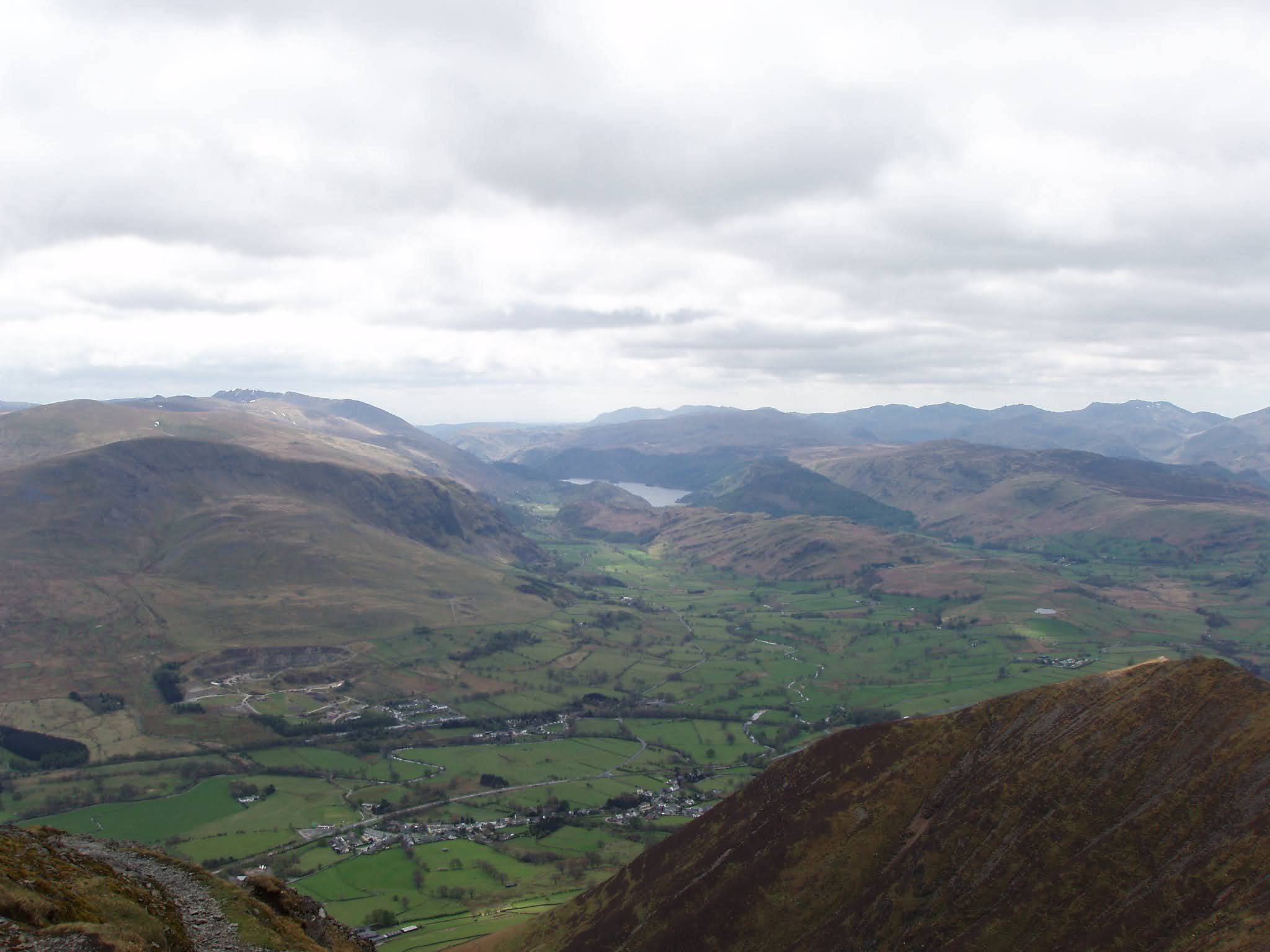
The view of Thirlmere from Blencathra


Looking towards the northern section of the reservoir, from the ascent Browncove Crags ascent of Helvellyn.


In the afternoon of Sunday 13th May 1888, William and some of the other reservoir workers went into Grasmere, returning worse the wear with alcohol; which they also brought back to the huts. Two of the lodgers were a Thomas Peak and Thomas Forrest. They all had dinner and later Agnes herself went to bed upstairs; Thomas Peak, in his stocking feet, also went to his room. William was in a drunken state and remained downstairs but it was not long before he himself decided to make his way to bed. When he went into the room he found a sight he did not expect, Peak was in the bed with Agnes. Peak quickly left the room, and William, clearly furious with the sight he had been confronted with, went back downstairs, grabbed a loaded shotgun and returned to the bedroom with a wild look in his eye. The others heard the discharge of the gun and both Peak and Forrest dashed into the bedroom to find William stood over his injured wife, reloading the weapon. Both men immediately jumped on Gill and it was then found that on the discharge of the gun he had peppered his wife's face with the shot. She had tried to dash out but William had either aimed poorly, or Agnes had ducked or fallen; the main shot hit the bedroom door. The bulk of the discharge missed her but she was still struck in the face and scarred. Although no official report by Agnes was made to the police about her husband shooting her, news quickly spread, and the Grasmere constable heard about the incident that night, and detained William for an offence of Attempted Murder.

He was brought before the Ambleside Magistrates on Monday, and then again on Wednesday, for the purpose of examination. The chief witness was Agnes herself, but it soon became obvious when questioned by police superintendent Shields that she was unwilling to give any evidence that incriminated her husband in such a charge of attempting to murder her. She at first stated that she was unsure of William had fired the gun when she was still in the bedroom. She had to be threatened by the court with imprisonment before she admitted that it was, but again said that she could not say whether he did it to try and injure or kill her, or merely to frighten her. Better evidence came from the two lodgers, Peak and Forrest, who gave their accounts. Peak had admitted following Agnes to the bedroom and being caught in bed with her by William. Neither could say whether the aggrieved husband's intent was to wound or merely frighten his wife. The magistrates were satisfied that he should stand trial and remanded William to appear at the Summer Westmorland Assizes.

That William found himself in a situation not of his own making, was obvious, but it was clear he should not have taken the violent, life threatening action that he did. Sympathy was clearly felt towards him, displayed firstly by his errant wife, but also by the courts themselves. On Monday 4th June, his solicitor put the remand before Mr. Justice Charles, of the Queen's Bench. Having then looked at the circumstances he decided to release William on Tuesday, on his own recognisances of £100, and two other sureties of £100 each. 

The case was then before Mr. Justice Stephen at Westmorland Assizes Court, held at Appleby on Wednesday 4th July. The judge took his seat at 10am and went through the case summaries after swearing in the Grand Jury. He outlined the case of William Gill, who was charged with attempting to murder his own wife. He said that it was a strange case, but appeared more formidable than it really was. That the gun had been discharged was without doubt, but whether it was with the intention of killing his wife or merely to frighten her was in question. He said that the accused's wife and the lodger both gave very confusing accounts at the hearing; he commented that the latter ought to have been thoroughly ashamed of himself. He made the final point that although a serious incident, there had been great provocation, and that this, he expected would have an affect on their judgement. The Grand Jury agreed and decided that there was no case to answer, and returned a 'No Bill' judgement, meaning no trial took place. 

********************

One could think that this was a story of a spurned husband losing his mind and trying the take the life of his errant wife who was unfaithful to him; it is not, it is a story of true love winning out! 

By the census of 1891 the Gill's were still at the Lake Foot Huts, and there were ten lodgers (Thomas Peak was now not one of them). William and Agnes added to their family with the birth of another son, Joseph Henry, born in the second quarter of 1889. William no doubt did the maths and was satisfied that the birth was far enough beyond the 9 months gestation period to have been the result of Agnes's infidelity. They were still together in 1901 and were in the Burrington area of Hereford; William was still an engine driver. 


Tuesday, 17 November 2020

The Pennine Bridleway 'Murder' between Clapham and Selside.

If anything awakens the sleepy nature of an rural isolated community, it is the finding of a body in that otherwise peaceful area, especially where a mystery surrounds its finding and identity. One of the more well known and often referred to one, is the pack woman's grave in the Langdale Valley of Lakeland, now a mecca to be visited by walkers of the valley and summits of the Lake District, especially following a reference in the famous Wainwright guide books of the 214 similarly named summits. The pack woman's grave is denoted by a cross near Rossett Gill; although a location of some antiquity, it is believed that she was merely overcome by the weather, with no marks of violence on her remains. Over many years, it would not be surprising that other remains were discovered at intermittent times, across the nation.

One such event, in terms of geography, occurred in North Yorkshire, but surprisingly is not referred to now. On the afternoon of Wednesday 9th September 1936 a minute search was made of the area of the limestone plateau between Clapham and Selside, where the famous clints were to be found and taken for the decoration of alpine gardens. This track skirts the southern flank of the well known mountain of Ingleborough and is part of the national trail, the 205 mile Pennine Bridleway which runs from the Derbyshire hills to Kirkby Stephen in Cumbria. A Mr. R. Richardson had been collecting these clints for his employer, Jack Preston, to sell to gardeners for such decoration, and a few months previous he had noticed some bones, covered by limestone rocks, in a hollow in the clints, near the pack-horse track. These were in the area of Mr. T. Newhouse's farm, South House, near Horton-in-Ribblesdale.

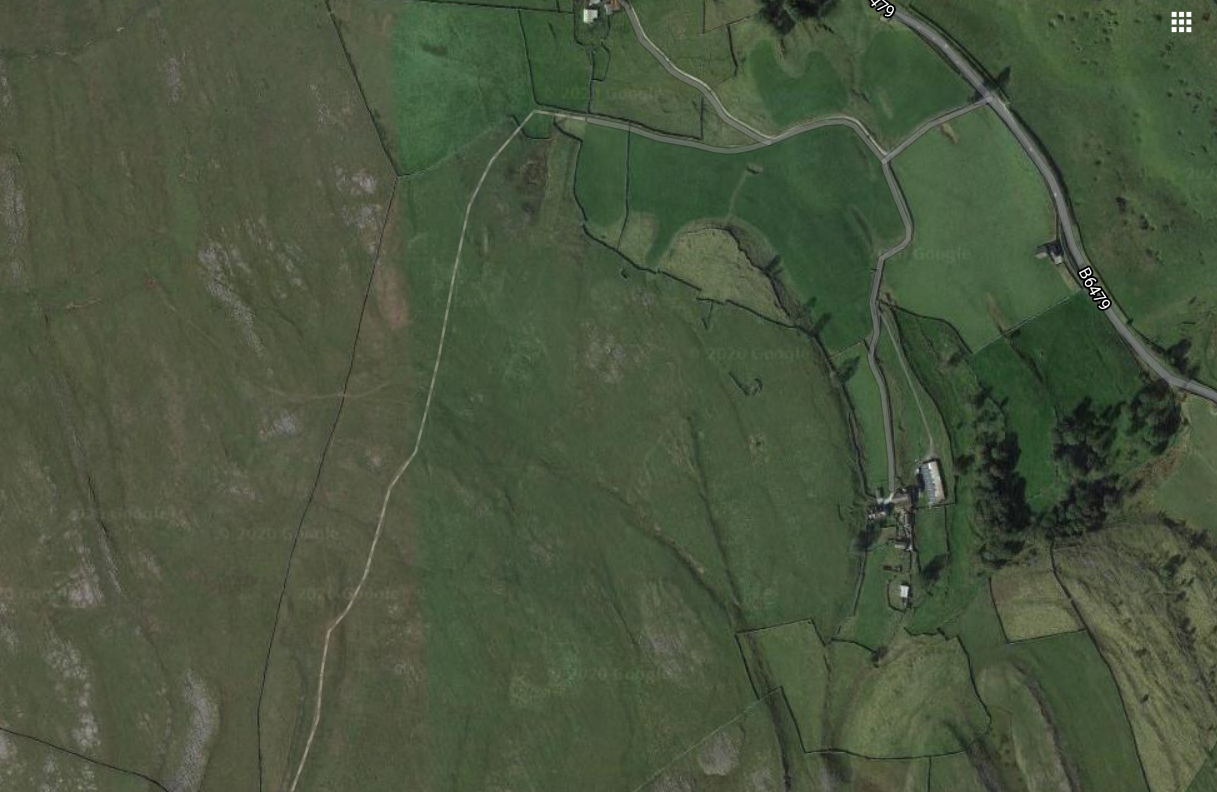
Plan view of the area with the Pennine Bridleway going through the Clints towards Selside, South House to the right. 

Ordnance Survey plan of the area. The red flag denotes the general area where the skeletal remains were believed found,

Mr. Richardson regularly found sheep bones during the course of his searches and assuming these were such remains, he left them. That afternoon he decided to remove the covering rocks and take out the bones, intending to remove the clints for his employer when he realised that the skull was human. The bones were very weathered, with neither flesh nor clothing attached at all. Later in the evening he informed his employer and both went along to Settle police station and reported the matter. Superintendent Elliott and Sgt. Turnbull immediately went to the area and confirmed that the remains were indeed human and these were then conveyed to Settle Police Station. The bones had been in a cleft in the clint that was 7ft 6ins in length and 18 inches wide, and being partly covered with limestone boulders; it was suggestive of a coffin.

The scene where they were discovered, and the bones themselves, were inspected by Mr. Tot Lord, a well known Settle antiquary, who confirmed that in his opinion they were of some considerable age, likely centuries old. They were bleached and had suffered in condition from the wind and rain. He believed them to be the remains of a woman and she had suffered from fractures both to her arm and skull. The best theory was that she had been waylaid on the trail, likely in the days of pack horses, and had been buried in the clint. It was decided that no inquest was necessary, due to the historic nature of the death; it is unclear where her unidentified remains were buried.

The strange event seems to have been once again forgotten. In reality, such a route back in 1936, would have been used mainly for local travelling between these isolated communities; war was soon to follow, which would understandably turn all eyes away from such small and unrelated events. However, such incidents, if recalled, are now points of interest to those seeking recreation and exercise in more modern times of leisure activities and are a 'must' to refer to as any party passes the path of such tragedy, especially where violence likely brought an end to a life.


Sunday, 15 November 2020

The Death of Shepherd Johnathan Thompson on Blencathra in 1882


Blencathra/Saddleback, with Blease Fell towards the left.


Johnathan Thompson was born in the 2nd quarter of 1860, the son of a 34-year-old lead miner, also called Johnathan, and 28 year old Sarah, nee Birkett. At the time of his birth he had three elder brothers, William, John, and Joseph, and the family lived at Rosthwaite, Borrowdale. The family was expanded over the next 10 years to include a further two daughters, then a son; then a further daughter. Jonathan grew up knowing the whole area and in adulthood he found work with a local farmer called Thomas Bainbridge, at Doddick, Threlkeld, and was there when the 1881 census was conducted. At the Whitsuntide of 1882 he moved to a nearby farm, that of Mr. D. Fearon, of Gate Gill Farm, also at Threlkeld. Jonathan was a strong robust young man and was well known in the wrestling circles of the northern area.

 At 7:30 on the morning of Saturday 2nd December, Mr. Fearon and Jonathan went to the intack (land, usually 12 hectares, or 30 acres, meaning 'taken in' from the fellside/moorland) to the ewes and tup. They were to put them out on the mountain and Jonathan went onto Blease Fell with the dog at around 8am, to get another couple of ewes. This caused Mr. Fearon no concern as the weather was fair and his young shepherd had fulfilled that role all summer and knew the area well. 

Blease Fell, taken from the base of the Jenkin Hill route up Skiddaw.


Mr. Fearon expected Jonathan to return around noon but sometime just after this only the dog returned. He became concerned and went searching the fell with a neighbouring farmer; they were soon joined by another two men but nothing was found of Jonathan, and the winter weather deteriorated rapidly into the afternoon. The search was recommenced on Sunday and there was approximately 100 searchers looking for Jonathan. By now they would be expecting to find a corpse, unless he was towards the valley floor; again, nothing was found of him. The search once again recommenced on Monday 4th. During the forenoon a check was made of the Knowe Crags area of Blease Fell, and finally a body was spotted below the crags in a ravine; it was that of Jonathan. He had clearly fallen from the edge of the crag and was near a place known locally as The Rake. The body was on its back, with the head facing upward to the fell-top.


The path along Blencathra ridge, with the close sheer drop to the right - walking towards Halls Fell summit and the trig point.


The summit of Blease Fell with Knowe Crags to the right, Gategill Fell ahead, with the steep drop.


Looking over the southern ridge of Blencathra and the drop


Looking up to Blease Fell/Knowe Crags, with Gategill Fell to the right.


Gategill Farm, immediately below Knowe Crags


Looking down from Knowe Crags to Threlkeld, Gategill Fell to the left.


The Rake? Centre of Blease Fell and Gategill Fell.


The Blencathra Ridge, viewed from Blease Fell area.


The curve of the hollow at Blease Fell, the full Blencathra Ridge in view.


Looking back to Knowe Crags with the steep gradient.


The body was taken to Gate Gill Farm and an inquest was held on Tuesday by Mr. John Carrick Esq., the East Cumberland coroner; the jury foreman was Mr. William Taylor, of Threlkeld Hall. After formal identification, the cause of death was given, Thomas had  died of a broken neck, Mr. Fearon's evidence was given before the coroner concluded the proceedings. Mr. Carrick stated that as the death had been a violent one, such an inquest was necessary, but as no-one had been with him it was clear the death was accidental. The jury agreed and returned an Accidental Death verdict; they declined their expenses, handing them to Mr. Fearon to pass to the grieving mother, Sarah Thompson. 

Jonathan's father appears to have died in the first quarter of 1876, aged 51 years. In 1881 Sarah is known to be a widow, still living at Stonethwaite with four of her children; the oldest was William, now 29 years, the youngest, Charley, aged 7 years.


The following poem was taken from the English Lakes Visitor newspaper, dated 16th December 1882:

'LINES ON THE DEATH OF JONATHAN THOMPSON, Who was killed on Blencathra, on Dec. 2nd, 1882. 

Cold, cold blew the wind in the month of December, 

Bitter the blast as it rushed down the steep. 

A brave shepherd boy left the Farm by the Lead Mine, 

With fell staff and dog, to attend to his sheep; 


He climb'd the bold front of the ling-covered mountain, 

In the vigour of youth he kept on his way, 

Anon looking down on the valley beneath, 

Where the village of Threlkeld so peacefully lay.


Still onward and upwards, not dreaming of danger, 

Through half-frozen snowdrifts he trudged along, 

While hither and thither his faithful dog sending, 

To search out the stragglers the wild rocks among. 


How little he thought when he left the old homestead, 

That soon his young life would be taken away. 

Oh! sad was his fate, for his young frame lay shattered, 

On the cold mountain side, ere the close of the day.


He had reached Knowe Crag by a dangerous sheep track, 

Well known to the hunters and dalesmen of old, 

The hurricane swept down the gorge of Blencathra 

And made the young shepherd to shiver with cold; 


A moment he stood on that dangerous place, 

One last look he gave ere he turned to go, 

One false step he took on a slippery snowdrift, 

Which hurled him to death it; the ravine below. 


'Twas hard thus to die in youth's early morning, 

Beneath the steep rock, on the snow-covered ground, 

With no friend to caress him, no mother to bless him, 

All alone there he lay where his body was found. 


In a quiet churchyard near the home of his mother, 

He peacefully sleeps, from sorrow set free, 

Awaiting the call that shall bid him awaken, 

To join his lost friends, and with Jesus to be. 

J. B. Orange Grove, Threlkeld.' 


The poem seems to indicate that he was buried at Stonethwaite churchyard but I am at present unable to check registers to confirm this.

Wednesday, 11 November 2020

The Death of Dunbar Usher of Keswick, in 1938 on Broad Stand, Scafell.

Dunbar Usher, Taken from 10th May 1938 edition of Penrith Observer

Dunbar Usher was the grandson of James (Jas) and Margaret Usher of Keswick and was born in the first quarter of 1905. He was brought up by his grandparents and accounts refer to him as their son, which he was not. Official records of his birth have no listing of his mothers' maiden name, usually indicating a child born out of wedlock and the child's surname being that of the mother. James and Margaret had two daughters, who, by nature of their age, could have been Dunbar's mother. They were Julia, who was born in 1881, and Jane Lavinia Usher, who was born in 1886. Julia appears to have married a Herman Diprose Phillips in 1909 and they emigrated to Canada. Jane Lavinia also went to Canada, in 1910 and one would assume it was to stay or live with Julia; the latter gave birth to a daughter in 1910. It may be that Jane emigrated to assist her sister, and/or to start a new life and further her opportunities. One piece of information on a research site is that Jane was Dunbar's mother, and as a young woman it is more likely to be the case. Certainly she returned to England in 1912 and it would not be hard to understand that if she had a child back in Keswick, despite the knowledge that her own parents were raising him, that union of a mother with her child may have proved too difficult to sever permanently. This is of course a speculation beyond the fact that Dunbar was raised by his grandparents and Jane's emigration and return.

Little is known of Dunbar's early life but in February 1924 the local conservative MP set up a Junior Imperial League (IMPs) for the Keswick area. Dunbar was part of a group of musicians at the meeting and he would come to be closely associated with the IMPs of Keswick. He is then recorded as being a committee member of the Keswick Conservative Club. By February 1926 he was quoted as the leader of the Keswick IMP's and also recognised as a great orator, now being marked as a future leader of the Keswick conservatives, once he reached greater maturity. There is no dispute that he took every opportunity to forward the cause of the IMP's and conservative values within the Keswick area, for the greater good of the population of the town.

Monday 11th April 1932 saw a snow blizzard quickly develop and gave a great insight into the selflessness of Dunbar, in his drive to help anyone who needed his aid. A young Borrowdale man by the name of Robert Robinson had gone climbing in the afternoon on Black Crag Gully, behind the back of the Borrowdale Hotel. It was shunned by many because of its treacherous nature, especially in bad weather. He had managed to get half way up the gully before he got into difficulties. He shouted for help and was eventually heard by Albert Black, who was working half a mile away. After being informed by Robert that he could neither move up nor down, Mr. Black then went into the valley and telephoned Ralph Mayson the renowned Keswick climber. He and a Robert Holmes attended after half an hour from receiving the call; by now the cloud was down and it was getting dark with a blizzard now having set in. By rope Mayson eventually descended to assist Robinson, but was still 60 feet short. At this point they were joined by Dunbar, who had raised another 100ft rope. Lashing the two together they were able to get a rope end to Robinson who was then tied on and raised out of danger. He had been crag-fast for over four hours, and was suffering severely from the increasingly freezing conditions, but was safe and eventually walked off the mountain. 

On Thursday 8th March 1934 Mr. Dennis Wivell retired from the Crosthwaite Ward of Keswick Urban District Council and Dunbar was elected in his place, putting him then in the forefront of local government decisions.

In 1934 the ground-breaking film 'High Hazard' was released, by its producer, Mr. Stanley Watson, who was Chief of the British Mountain Guides; this was the first complete record of British Rock Climbing. Mr. Watson couldn't get film producers interested, nor actors to perform the shots he wanted, so made the film himself and used local climbers to enact the climbs. In fairness, only they could perform those required feats. In the link, if the reader or viewer, scrolls along to 5mins 47 seconds, they see the below shot of Dunbar.

https://www.youtube.com/watch?v=36OeMUwT0Ro&t=170s

Dunbar Usher is in the centre, wearing a beret and glasses.


Climbing on Glaramara during filming.


The film shows the esteem which Dunbar was held in and it was widely reported in the press that the local Keswick councillor had been one of its' stars.

On Sunday 1st May 1938, two women were climbing on Scafell Pinnacle. They were Eva Bailey, a 27 year old biological chemist of Edinburgh Infirmary and Miss Nan Hamilton, of Carlisle. Hamilton was leading when Bailey fell a distance of 100 feet while roped together. Hamilton managed to break her fall with the rope, but it snapped and she fell a further 100 feet and was killed. It was the start of a tragic week on the mountain. Six days later, on Saturday 7th, Dunbar Usher and J. G. Hayton of Keswick, a Penrith schoolteacher, were climbing the 100ft high Stand Crag, on the south face of the mountain. This was regarded as a difficult climb, but well within the capabilities of both these experienced climbers. Both men had ascended about half way and had come to a ledge. Dunbar was a short stocky figure and could not grasp a fresh hand-hold to gain further height, so he asked his companion to move further along so he could then stand on his shoulders. Hayton did this, grasping the rock face and arching his back to allow Dunbar to climb up onto him. In this position Dunbar still had difficulty in finding a hand hold, and Hayton advised him to come down off his shoulders. He felt his colleague make one last attempt to find a hold, then heard a click, as if a piece of rock had come away after it had been grasped by Dunbar. Suddenly he was aware of his climbing partner hurtling past him down the mountain, only to stop after about 50 feet as the rope he was tied to arrested is fall. Mr. Hayton quickly descended to his colleague and found him unconscious, but appeared to have no broken bones. He dressed a head would  and saw someone lower in the valley, so went for assistance. It was a shepherd called Tom Bainbridge, who then went up to the accident scene; Hayton himself further descended to Burn Twigg in the valley floor, for a stretcher party. When he and a rescue party managed to return back to Stand Crag they found that the injured Usher was now dead.

The inquest was held at The Wastwater Hotel on the afternoon of Monday 9th. Evidence was largely given by Mr. Hayton, who recounted the events that lead to the tragedy, and Mr. Frederick H. Usher, Dunbar's uncle who he grew up with; he provided the antecedents of his life. He was able to inform the court of Dunbar's huge influence on the political scene around Keswick and the surrounding area. He had been involved with the IMP's for 13 years and made it the influential organisation it was up to that day, making the Divisional Council and County Federation the success they were, never missing a meeting. Although the youngest, he had been a member of the Keswick Urban District Council for five years and close to being its next chairman. 

 Dr. Norman gave evidence that Dunbar had died from a broken neck. The inquest concluded that night and unsurprisingly, the verdict was one of 'Accidental Death', but the coroner did not conclude the proceedings before he critically commented on this being the second such inquest he had conducted that week and it appeared to him that too many unnecessary risks were being taken by climbers.

The funeral took place on Tuesday 10th and was one of the largest Keswick had witnessed. There were around 100 wreaths that accompanied the coffin to Crosthwaite church and on this was placed his climbing axe and rope. Representatives of all the political organisations he was associated with, along with social clubs, were present, both in an organisational capacity and one of friendship. Apart from family and Mabel Armstrong, Dunbar's fiancée (who was from Penrith and a maid for General and Mrs. Spedding, at Windebrowe), prominent attenders were Dr. Wakefield, of Everest expedition fame, and various members of the mountaineering fraternity from the Lake District. 

His grandfather James had died in 1918 and his grandmother Margaret had passed in 1933 at 20 Stanger Street. Dunbar, along with his mother Jane Lavinia and his other aunt, Margaret Helena, were also at this address. It is believed Jane Lavinia had emigrated to Canada in 1910, but appears to have returned in 1912. It may be that she went to live with her older sister Julia Ann, but that is unclear. In Dunbar's probate he left just over £1,100 to Jane Lavinia (his likely mother) and aunt; the address was 20 Stanger Street. In the 29th September1939 electoral roll, both Jane Lavinia and Margaret Helena are shown as unpaid domestic servants at 72 Thornton Road, Morecambe, the residence of David Jackson, a building house keeper, and his wife Ethel. 20 Stanger Street is shown with no occupant at that time, as is number 18. Dunbar's mother died in 1974 and her probate shows her at 20 Stanger Street, so it was still a family residence.

The forthcoming months after Dunbar's death saw the election for a new council member, meetings of the Further Education Committee, the annual meeting of the IMP's, attended by the Mayor, and the annual meeting of the Conservative Club, the latter occurring on Thursday 15th December where a photograph of their esteemed deceased former member was presented to them. All these events saw eulogies being given, placing Dunbar in the highest of esteem by his fellow colleagues of all organisations or clubs.


Thursday, 5 November 2020

Thomas Clarkson, Slavery, and Hallin Fell, Ullswater


The Thomas Clarkson Anti-Slavery Memorial at Eusemere, Pooley Bridge


Slavery issues – Ullswater

Cumbria had its clear connections with slavery, particularly the coastal town of Whitehaven with its Caribbean connections, indicated through the references to rum (The Rum Story) and Cumberland Rum Butter as a delicacy now eaten at Christmas, though back in those times, eaten from a particular dish at celebrations such as births. However, one would not have expected it to be a hotbed of the Abolitionist, or Anti-Slavery Movement, but it was, or at least the old County of Westmorland was, particularly centred on the southern shores of Ullswater, and around the associated town of Penrith (just inside Cumberland).

The men who were the nucleus of this movement for change in the evil trade of African human cargo were, Thomas Clarkson, and Lord (Henry Peter) Brougham, supported by other local man, such as the Quaker Thomas Wilkinson, and other great men of influence. Below is an account of these men, with reference to those locations.

Thomas Clarkson (1760 - 1846)

Thomas Clarkson, by Carl Frederik Von Breda


Thomas Clarkson was born in Wisbech, Isle of Ely, Cambridgeshire, on 28th March 1760. The eldest son of Reverend John Clarkson. He attended Cambridge and obtained a B.A. Degree and became a deacon in the church, although never proceeded to priest’s orders. Whilst at University he had entered a competition, set by the university vice-chancellor, asking: ‘Is it lawful to make slaves of others against their will?’ After extensive research on the subject, including the reading of earlier works by abolitionists and interviews with those involved in the trade, he won the competition and had to read the essay to the Cambridge faculty. On a journey he had a revelation and later wrote:

‘As it is usual to read these essays publicly in the senate-house soon after the prize is adjudged, I was called to Cambridge for this purpose. I went and performed my office. On returning however to London, the subject of it almost wholly engrossed my thoughts. I became at times very seriously affected while upon the road. I stopped my horse occasionally, and dismounted and walked. I frequently tried to persuade myself in these intervals that the contents of my Essay could not be true. The more however I reflected upon them, or rather upon the authorities on which they were founded, the more I gave them credit. Coming in sight of Wades Mill in Hertfordshire, I sat down disconsolate on the turf by the roadside and held my horse. Here a thought came into my mind, that if the contents of the Essay were true, it was time some person should see these calamities to their end. Agitated in this manner I reached home. This was in the summer of 1785.’

He then translated the essay from Latin into English to gain a wider audience and it was published in 1786 under the title of: ‘An essay on the slavery and commerce of the human species, particularly the African.’ In 1786 he also met William Wilberforce, and both would come to be the two titans of the anti-slavery movement. Wilberforce entered the abolitionist cause shortly after Clarkson, but it was never a question of who could gain the most honour, but who could do the most good; both would work to enhance the effectiveness of the other, for a common and Godly cause.

From these beginnings of the anti-slavery campaign the ‘Society for the Abolition of the Slave Trade’ was commenced on 22nd May 1787. Members included Granville Sharpe as the chairman, with a total of 17 members, including Clarkson and Josiah Wedgewood. (Sharpe (1735-1813) had been involved in the Jonathan Strong case where he had managed to free Strong from his master. In 1772, having gained a reputation as the champion of the oppressed African he championed the cause of James Somerset a slave about to be transported to Virginia. He not only freed him but set the law, namely, as soon as a person set foot on English soil he could not be held as a slave, he was a free man. This was the first major anti-slavery decision.)  In that year of 1787 William Wilberforce wrote in his diary that his great purpose in his life was to be the suppression of slavery. It would be Wilberforce who would press the matter in parliament, supplied with a body of evidence researched by Clarkson. Their friendship would last throughout the whole of their lives. He was so fervent in the gathering of his evidence and influence of other’s views, including trips to France and the French aristocracy, that his health suffered. Part of his inquiries had led to his life being threatened in Liverpool and the plantation owners threatened to sack any employee that gave him any information on the slave trade. It was virtually impossible to disprove the plantation owners account that the slaves were bought at fairs in Africa, until he heard of a sailor who had told of being present when slaves were torn from their homes. His details were unknown, so Clarkson visited the navy ships at Deptford, Woolwich, Chatham, and Sheerness without success. He then went to Portsmouth and visited all the ships there, again without success. From there he went to Plymouth, a distance of 200 miles. There he visited 40 ships on the first day, again without success. Disheartened he visited the remainder on a second day and on the 57th ship at that dock he finally identified the man who confirmed that the slaves were dragged from their homes, which he had witnessed on several occasions. He brought his witness back to London for the purpose of obtaining a deposition from him and to give a first-hand account.

 Thomas’s health began to fail, and he was obliged to retire from the cause in 1794. He had travelled in excess of 30,000 miles, many journeys being through the night, building up that body of work on slavery issues.

Eusemere, on the south shore of Ullswater.

It was now that Thomas Clarkson had Eusemere built in 1795. He and his wife visited and loved the area of Ullswater, Clarkson having struck a close friendship with Thomas Wilkinson during his work on the anti-slavery movement. The Clarkson’s had initially stayed with Wilkinson at The Grotto, Yanwath, near Penrith, who advised them on the purchase of the land on which to build the house. Wilkinson himself had suggested the land and oversaw the building work. It was reported in 13th April 1954 edition of the Penrith Observer, that Thomas Wilkinson had left memoirs stating that Clarkson had renounced his orders to join the Society of Friends and had asked him to choose a site on the lake shore to build a house, so Eusemere was erected. Clarkson’s, ‘Portrait of Quakerism’, published in 1806 was begun under Wilkinson’s roof and was submitted to him for his critical oversight, prior to publication. Wilkinson was often looking at improving the lot of mankind and it was only after two years from the formation of Clarkson’s Society against the Slave Trade that Wilkinson himself wrote his poem, ‘An Appeal to England, on Behalf of the Abused Africans.’; his ulterior purpose had been to lend support and gravitas to Clarkson’s cause. Wilkinson had also witnessed the distress and virtual nakedness of the African on street corners of the capital city in the year of 1785. When Clarkson came north for his quest of evidence on the slave trade, Wilkinson had joined the circuit with him, and so their lifelong friendship had begun.

There were frequent and influential visitors to Eusemere, two of whom were William and Dorothy Wordsworth who would stop for prolonged periods. One such visit by them was in April 1802 and on their journey back to Grasmere they passed the shores of the lake, near Gowbarrow. The next day it was reported that the poem ‘Daffodils’ was written (this was probably Dorothy in her diary, as it is known William wrote the poem some considerable time afterwards, it being a poem of memory). Other visitors had been Sir Walter Scott, Thomas Penson De Quincey (the English essayist who for a time 1820 – 1825, lived at Rydal), Samuel Coleridge, Charles Lamb, and William Wilberforce. Most visitors would then go to mount the famous mountain of Helvellyn by the Striding Edge route. He and Wilberforce, would sojourn along the banks of Ullswater where both would discuss this great cause that would forever occupy both the lives.

Unfortunately, this association with Ullswater came to an end, beginning when Mrs. Clarkson took ill in the early summer of 1804 and she moved back to the south of England with her son, leaving Thomas as a lonely figure at Eusemere. Dorothy Wordsworth wrote of her concern at his loneliness. Thomas joined his wife in November of that year and only visited once more; the Wordsworth’s would visit the house which was then only in the oversight of a maid. The property was then tenanted to William Smith, MP., of Norwich, the grandfather of Florence Nightingale. The property was then bought by Lord Lowther who then owned it for 20 years. The Wordsworth’s themselves seriously considered living there, which may have meant that they would come to have been buried at Barton, not Grasmere.

Thomas Clarkson returned to the political scene in 1805, touring the country once more to gain evidence and promote the anti-slavery cause. It was during this period that William Pitt the Younger died on 23rd January 1806. The ‘Act for the Abolition of the Slave Trade’, which all had worked towards, was finally passed on 25th March 1807. The key debate had been on 23rd February and the vote was 283 votes for, and 16 against; it was one that far exceeded their expectations, and Wilberforce received a standing ovation. That work had been greatly enhanced by the drive and research of Clarkson. However, it would take until 1833 before slavery was finally abolished in its entirety.

One could not be a firm friend of William Wordsworth and admired by him, without the great poet making reference to such an individual in his poems. Of Clarkson he wrote a sonnet named:

Sonnet, To Thomas Clarkson, On the final passing of the Bill for the Abolition of the Slave Trade, March 1807.

‘Clarkson! it was an obstinate Hill to climb:

How toilsome, nay how dire it was, by Thee

Is known,—by none, perhaps, so feelingly;

But Thou, who, starting in thy fervent prime,

Didst first lead forth this pilgrimage sublime,

Hast heard the constant Voice its charge repeat,

Which, out of thy young heart's oracular seat,

First roused thee.—O true yoke-fellow of Time

With unabating effort, see, the palm

Is won, and by all Nations shall be worn!

The bloody Writing is for ever torn,

And Thou henceforth wilt have a good Man's calm,

A great Man's happiness; thy zeal shall find

Repose at length, firm Friend of human kind!’

William Wordsworth

Indeed, Wordsworth made a number of references to the trade in slaves and for further reading on the subject:

a)      'To Toussaint L'Overture' (1807)

b)     The Prelude (1805 Text) Book X, lines 203-228 (1805, 1st published 1926)

c)      The Prelude (1850 Text) Book X, lines 237-265 (1850)

Canon Hardwick Drummond Rawnsley was the vicar at Crosthwaite Church, Keswick and had commenced the National Trust with Octavia Hill and Sir Robert Hunter. In his ‘Literary Associations of the English Lakes’ he wrote of Eusemere and Clarkson:

“We are anxious to visit Eusemere, the seat we know of that worthy Thomas Clarkson of whom Southey once said that, ‘his name would hold an honourable place in the history of England,’ who began the discussion concerning the slave trade in this country, and who by the indefatigable and prodigious exertions which he made, well-nigh ruined his health and his fortune. Of this father of the cause of freedom for the slave, no one who visits Pooley Bridge and looks across Ullswater to the white house on the eastern shore, but must think tenderly and gratefully – proudly too – that he found in the society of these hills a strength to stimulate and inspire him and his able wife with courage for the uphill task which he, ‘Duty’s intrepid liege-man,’ ‘starting in his fervent prime,’ first to ‘lead forth that enterprise sublime,’ dared for God and humanity.”

Following Clarkson’s departure from Eusemere due to his wife’s health, he had written back to Thomas Wilkinson in 1806 saying, ‘My heart is still in Westmorland, and I long to be among the mountains again. I do not mean on a visit, but to live and die there; though now I must strain every nerve for the Total Abolition, which if once accomplished, I shall think of returning to private life.’

Thomas Clarkson was the first president of the Anti-Slavery convention and the head office of Anti-Slavery International, in Broomgrove Road, London, is still known as Thomas Clarkson House.

He died at his home in Ipswich on 26th September 1846 at the age of 86 years and never gave up the righteous cause of the emancipation of the oppressed of the human race. It was said of him that he was the man who excited Wilberforce to labour for the abolition of the slave trade.

On 21st May 2017, the Thomas Clarkson Memorial was unveiled on the shores of Ullswater, below Eusemere, with members of the Clarkson family present, along with the local artist, Jimmy Reynolds.. It was based on the 1787 image by Josiah Wedgewood, which was originally on a medallion of the day, designed to promote the Abolition movement. It was of an African in chains on one knee, looking up with his hands clasped in prayer, with he words, ‘Am I not a man and a brother?’ surrounding the image.

Thomas Wilkinson 1751 - 1836

Thomas Wilkinson, of The Grotto, Yanwath, was born on 29th April 1751 and he was a Quaker, the son of Christopher Wilkinson. He was at heart an agriculturist but spent his life in the emancipation of slaves; he was also a poet and became known as ‘The Bard of Westmorland.’

He was friends all his life with Charles Lloyd, the banking poet, Burke, William Wilberforce, but above all, and as stated earlier, with Thomas Clarkson, who he worked tirelessly with to end slavery.

Thomas Wilkinson, an author of ‘A Tour of British Mountains’ and other miscellaneous works, died on 13th June 1836 and was buried at Tirril Quaker graveyard. More than 30 years previously he had been present when the artist Charles Gough had been buried at the same churchyard. Gough had been a Quaker but had joined the militia, and so was disowned by the society. When he was found dead by a local Shepherd on Helvellyn, with his faithful dog Foxie by the side of his emaciated corpse, it was Thomas Clarkson who had persuaded the Tirril Quakers, most likely the Wilkinson’s, to allow his skeletal remains to be buried there, and this was acceded. It had been the Wilkinson family who had given of the land to the Quaker’s for a meeting house to be built there in 1733; it was rebuilt in Thomas Wilkinson’s time. For further reading on Charles Gough, see:

https://scafellhike.blogspot.com/2019/09/charles-gough-faithful-dog-and.html

Wilkinson was himself a poet, but largely forgotten. However, his prose, admitted by Dorothy Wordsworth, was the basis of William’s great work, ‘The Solitary Reaper’.

Wordsworth wrote a poem called ‘To the spade of a Friend’. This ‘friend’ was Wilkinson, who is mentioned in the first line. He had described Wilkinson as, ‘He was a Quaker, of elegant habits, rustic simplicity, and with tastes too pure to be refined.’

Wilkinson wrote a poem called ‘Emont (Eamont) Vale’, and in it said:

‘Here Wilberforce from listening senates came,

His bosom glowing with a holy flame.

He viewed a quarter of this goodly earth,

Cradled in chains the moment of their birth;

From bad to worse he saw a people hurl’d,

The tortured slaves of an unfeeling world.

With views like these he entertained the plan,

To raise th’ unequal scale of suffering man.

Conviction heard his voice, and Britain rose,

A host of partners in the righteous cause.

Go, Wilberforce! Assist the labouring state,

Where British wisdom leads the high debate!

Perform thy part; - then far, in the mountains rude,

Come to the pure delights of solitude!


 Here indefatigable Clarkson stay’d,

His weary foot, and slept in Eusemere’s shade.

For wrong’d humanity long toils he bore,

Sought slumbering Truth around from shore to shore;

Brought such a scene of wickedness to light,

Astonish’d England shuddered at the sight.

Though here a while he found a place of rest,

Sad Afic’s woes still lingered in his breast.

Yet as he took his solitary rounds,

The mountain breezes soothed his inward wounds.’

In support of both Wilberforce and Clarkson, in 1787 he had issued, ‘An appeal to England on behalf of the Abused Africans.’ He was known to have gone into Penrith market with a large plan of a slave ship. He would lay this out and explain to those who gathered around, the horrible way by which the enslaved Africans would be transported from West Africa to the West Indian plantations.


William Wilberforce (1759 - 1833)

Wilberforce used to rent Rayrigg, at Windermere, to replenish the soul and would invite others, including William Pitt to stay with him. He is first recorded as staying with Lord Muncaster at Muncaster House in the summer of 1784 and taking up a residence near Rayrigg. He was friends with William Cookson, the uncle of William Wordsworth and would holiday in the lakes and come to love the area. He was known to still be holidaying in the lake district as late as 1818, with his family and large entourage of servants and horses.


Henry Peter Brougham (1778 - 1868)

Henry Brougham as a young man.


Henry Peter Brougham came from an ancient Westmorland family of Brougham Hall, near Penrith. He was born in Edinburgh in September 1778 and was educated there. He studied law and natural sciences. Despite having several scientific papers published he chose law as his profession. He was one of the founding fathers of The Edinburgh Review in 1802. He was to move to London through his involvement in certain important legal cases, and while at London became a fervent supporter of the Abolition of Slavery. He entered parliament in 1810 and had various periods there as a Member for Camelford (1810 – 1812), Winchelsea (1815 – Feb. 1830), and Knaresborough (Feb. 1830 – Aug. 1830), before moving to The House of Lords in November 1830. He was Lord High Chancellor from November 1830 to July 1834.

He became known as a champion of the oppressed and downtrodden, he was also the first president of ‘The Society for the Diffusion of Useful Knowledge’, and was a passionate believer and mover of the cause of education of the masses, including adult education, also of the large scale reform of capital sentences. He became known chiefly for his work on the cause of the complete abolition of slavery around the world.

In June of 1810 he carried through the House of Commons an address to the King, both direct and diplomatic, for the suppression of the slave trade. It was a marker for the country of his skills as an orator and bode well for him being marked for greatness. He was successful in 1811 with his bill for the punishment of individuals in the participation of the slave trade, which passed without opposition (The Slave Trade Felony Act). This carried sentences of either 5 years imprisonment or 14 years transportation, and he was supported in this by others, including William Wilberforce. This bill brought about a huge reduction in the traffic of slaves but did not eliminate it altogether. In 1823 The Anti-Slavery Society was formed; three of its members were Wilberforce, Clarkson and Brougham.

In 1824 Henry Brougham carried a further Act through parliament which now made the sentence a capital one; no-one now dared to breach this law, at pain of death.

In 1831 there was a large-scale revolt in Jamaica that resulted in a large loss of life. This caused two inquiries by parliament. In 1832 The Reform Act swept away ‘rotten borough seats’ in parliament, where plantation owners had used these to adversely influence the decisions of the government on slavery matters. This then allowed the passing of the Slavery Abolition Act of 1833. Unfortunately, Wilberforce died just after its 3rd reading in July, so never saw it receive Royal Ascent in the August. Although slavery had now ended, older former slaves were then apprenticed to plantation owners, so were not fully released until either 1838 or 1840, but that evil trade had then ended, plantation owners being paid compensation for their loss.

It was in the year of 1864 that Lord Brougham turned 86 years of age and a long time friend and fellow politician of Joseph Wilkinson of Bonscale, that Wilkinson erected a 12 foot high memorial cairn on nearby Hallin Fell, which is on the eastern shore of Ullswater and just over 3 miles down from Eusemere. The cairn was erected to celebrate Lord Brougham’s life-long work of service to the disaffected and the poor, irrespective of race or creed. Most notable of all was his early work over many years in the total abolition of slavery.


The Hallin Fell Obelisk, or Brougham Pillar

For further reading on Lord Brougham and his work: 
https://scafellhike.blogspot.com/2019/12/the-hallin-fell-obelisk.html

He died in Cannes on 7th May 1868 and is buried there. There is a statue to him in that town, for it was he who discovered it as a place of recuperation and that alone turned it from a mere small fishing village to become the resort of the rich and famous that it is now. He had bought land and constructed a villa there, which attracted other notable people of wealth and establishment.


Further Slavery Related Poems:

Refer to: https://brycchancarey.com/slavery/poetry.htm

Another work was ‘Ullsmere’ by John Charles Bristow, a singular work published in 1835 and Clarkson is mentioned in Part II, on page 88, verse XVIII:

https://books.google.co.uk/books?id=ma9gAAAAcAAJ&printsec=frontcover&dq=John+Charles+Bristou+Ullsmere

 

Monday, 26 October 2020

Auld Will Ritson of Wasdale Head

The Wasdale Head Hotel, owned and extended on by 'Auld Will Ritson'.

William Ritson was born in 1808 at Rowfoot, a small farmhouse at Wasdale Head, and would come to be renowned for his colourful and full life, at the head of that remote Cumbrian valley. He was the son of John and Anne Ritson and little is known of his early life with the exception of one account told in The Penrith Observer newspaper in October 1923, which gives an insight into his mischievous or 'embellishing' character. The young William had been with a friend in the valley when they were looking in a hollow tree for wamp (Cumbrian dialect for wasp) nests. They were accompanied by a  gentleman who was staying in the hamlet and the two boys blocked off the bottom of the hollow with dry grass and sticks for a fire. The other lad scaled the tree and filled the top with sods. Will's companion said, "Mind thoo doesn't set fire till't afooar Ah come doon." This gentleman then winked at Will, who took this as a sign and immediately set the grass and twigs alight. The wasps spewed out of the top, repeatedly stinging his companion, who raced to a nearby stream, immersing himself within its waters for relief against the pain inflicted by the many stings he received! The gentleman was so pleased to have been witness to such sport that he gave the boys half a sovereign; to one (our Will) it was easily earned, to the other, hard earned. In the same newspaper it was said that he could remember being christened and after running away and being dragged back, had threatened  the parson saying, "If thoo does that agean ah'll punch tha", when he had 'sprinkled' him. Many of the tales of his life were from various people who knew him well. John Ritson Whiting, a relative and later landlord of the Hotel, George Seatree, and J. W. Robinson (Robinson's cairn) of Lorton, Reverend John Hodgson of Netherwasdale, and Edwin Waugh, a noted Lancashire poet, were all valuable sources. 

Little is known of his education, but he would come to be a farm boy, husbandman, shepherd, wrestler, and a huntsman for Mr. Rawson of Wasdale Hall and also a Mr. Huddleston. He also was a boatman, guide, innkeeper, and last but by no means least, a humourist. His tales were affectionately known to be 'lies', but told transparently and without malice, to cause astonishment without disgust. Occasionally, when the opportunity presented itself, he would subdue any leg-puller with his even greater tales of happenings in the valley. 

He appeared in a wrestling match at Eskdale Sports and Fair in September 1829, so would have been 21 years old. He won, or 'stood', in the first 5 rounds, the 6th was the final and he found himself pitted against a George Addison; he stood in that round also and won the wrestling bout. Wrestling was part of his early life and he was a formidable foe. At the Keswick Sports of August 1831, he was not as fortunate, however; he progressed to the creditable third rounds in two events on the first and second days.


William married Dinah Fletcher, of Netherwasdale, and they had two sons, John (born 1836), and William (born in the first quarter of 1844).

In October 1849 a tour had been done by antiquity historians of West Cumberland and they required a guide with a great knowledge of the area. That guide was William and he led them through the Netherwasdale area, informing them that the confluence of the Bleng and the Irt was known to him as King's Camp from his early hunting days. Checks of historical maps by the antiquarians confirmed this. It showed William to have that local knowledge, invaluable for a such a group of researchers and an ideal place for some form of camp for protection of the valleys in more ancient and violent times.

The first reference that can be discovered to 'The Wastwater Hotel' was a fine dinner provided in April 1862 at the end of a fox hunt in the area, Mrs. Ritson's cooking being heartily recommended. In Whitehaven Archives there is reference to a visitors book at Row Foot (the original farm name) dating from 1857 to 1863. One would expect this to be the origins of the inn, then hotel, and it seems perfectly feasible that the business started firstly as what is now called a 'Bed and Breakfast', but expanded to be the renowned inn. Notable visitors listed for long periods are those academics of Oxbridge Colleges. William's father John died there on Wednesday 16th October 1867 at the age of 82. There are some references that the inn was initially called The Huntsman Inn, although the names seem to move equally between those two names and The Wasdale Head Hotel. It seems that Will, being a shrewd businessman, saw a developing opportunity with the tourists that would visit the area and Wasdale contained the highest mountain, the deepest lake, albeit the remotest of valleys. The establishment became a mecca for the new breed of climbers who would come to flock to the area, with easy access to the climbs of Great Gable, Pillar Rock, and the Scafells. These men were either noted within society, or of influence within the universities and connections in the press of the time. Through this, it is not difficult to surmise that The Wasdale Hotel and its strong characterised landlord, came to be renowned throughout the nation. Of Will himself, he saw no purpose in this new sport of climbing and would advise customers that it was a sure enough way to obtain a broken neck for their troubles; however, he still made a profit from their ill-judged passion.

William was a farmer and a huntsman and one would expect that combination would bring about a wish to exterminate any fox he would come upon, but that was not the case and he displayed a human aspect to his character. In February 1863 it was known that running about his yard was a tame full grown fox, previously thought to be an impossible feat for such a wild animal. It moved freely among his foxhounds, which he kept a small pack of. One can only assume he had raised it from a cub, perhaps following the death of its mother in a hunt. This scratch pack of hounds was said to have been the beginnings of the famous Eskdale and Ennerdale pack.

January 1864 found both him and his son William junior doing jury service, sadly at the home of his father and following the inquest into the death of the Wasdale Head schoolmaster and parish clerk of 18 years, 63 year old Mr. Isaac Benson. He was known to travel to Whitehaven every Christmas but due to fever in the town his visit that year had to be cancelled. He stayed at various houses in the Wasdale Head area and one of his pupils had recently contracted the fever. On Monday 18th January he was to vacate that house and believed that because of the fever, none of the other residents would take him into their abodes.. The number of pupils at the school had dropped and all these factors placed him in a low state of mind. He had left Mr. Ritson's public house at about 6pm on Saturday 16th January. The next day he was found in the schoolroom with his throat cut. The verdict was suicide.

That William was the great orator of many a yarn is undisputed, holding his audience spellbound with the increasingly broadening tale, yet the listener was held until the end, duped until the final sentence revealed a story so preposterous it surely could not be true? However, such an artist of deception was himself capable of being duped by an expert. William could be forgiven for being drawn in to a lie as his stories were always without malice, unlike that told of 'Thomas Ruddick', on 8th November 1866. He gave the air of a gentleman and had stayed at the hotel, arriving in October in a fine suit, although it showed signs of age. He left in the first week of November without paying his bill but the weather was inclement, so turned around, returned, and told old Mrs Ritson that her son had granted him permission to use his coat, before taking the road once again. This was also false and when this was discovered, along with his permanent departure, a search was made for him by Whitehaven Police. He was eventually found by Carlisle City Police and taken to Whitehaven, appearing before the Magistrates in May 1867. He was remanded for a week, awaiting his appearance at Bootle Magistrates, the offence occurring in their area.

Two ships were known to have been built in Whitehaven, each with the name of Wasdale. It was said that William was a shareholder in at least one of them, and both carried figureheads of Mr.  Ritson. Sadly, The one was lost; it had sailed from Whitehaven on 9th December 1868 and had been caught in gales. It never arrived at its destination of Newport with its cargo of iron ore. By 9th January 1869 reports were received that a large ship went into Lamlash Bay on the Isle of Arran, and reported having struck a two masted ship in a storm. They could not help the crew and the last heard was of them shouting to launch the boats. A boat with Wasdale on the side was picked up at Islay and a nameboard with Thos. Pickthall was also found. There had been seven crew on the Wasdale, the Captain was Thomas Pickthall, and he was regarded as a fine sailor. All left widows and families.

In 1873 cricket was sweeping the nation as a community sporting event, and Wasdale Head was no exception. Holmrook was challenged to a game, and one took place on 14th August, sheltered below the mighty mountains of Yewbarrow, Kirk Fell, and Great Gath. One would struggle to imagine how such a tiny hamlet could put together a credible team, but staying at William Ritson's was a Cambridge University party, including Richard Pendlebury who was the senior wrangler at the university. They had been staying there a number of weeks and it was they who challenged the Holmrook club, who duly accepted and the day turned out to be ideal cricketing weather. William and the Wasdale reverend ably provided the entertainment as the runs mounted, no doubt the beers flowed at William's bar too, so he would turn a healthy profit as a result. Holmrook won by 101 runs, over two innings but the day was so enjoyable that a second game was agreed and played the very next day at Holmrook. Although Holmrook again won, this time it was by a mere 14 runs. A William Ritson was a player for Wasdale Head, although this would likely be his son, who would be a far more likely contestant by way of age.

Perhaps the great measure of Auld ill Ritson's standing in the community was the reference the local people of the area gave to a small waterfall, just 500 yards up Mosedale from the hotel, which they named Ritson's Fosse, and this is displayed on modern Ordnance Survey Maps as Ritson's Force. 

In the year of 1876, two tragic events occurred in Lakeland, both having William Ritson and his Wasdale Hotel involved in the events. The first occurred in August 1876 and involved the disappearance of a London silversmith called Edward Barnard, who was eventually found dead in the Ennerdale valley, having been last seen on his walking expedition at William Ritson's hotel. The second occurred just two years later when on 1st May the 82 year old Reverend James Jackson set out from the hotel to climb Pillar Rock. When he didn't return a party of local shepherds was sent to search for him and he was eventually found dead on the mountain. For further reading the incident accounts I have recounted in greater detail in the below links:

https://scafellhike.blogspot.com/2015/12/the-disappearance-of-edward-barnard-in.html

https://scafellhike.blogspot.com/2019/06/reverend-james-jackson-memorial-cross.html

William had retired around 1879 and moved to Nicholground, Netherwasdale, with Dinah, who unfortunately died on 26th July 1888 aged 83 years, the funeral taking place on Sunday 29th at Netherwasdale. Dinah had been equally well known throughout the area, and a lake district tour had come to be regarded as incomplete without a visit to the Wasdale Hotel. William died on 4th March 1890 and was also buried at Netherwasdale Church on Friday. He had been in failing health following the death of his wife. By this time both of their sons had passed away, William junior in 1878 and John in 1888, but they had borne William and Dinah four grandchildren. Auld Will was regarded as being of a kindly disposition, ready to do a good deed for any neighbour and known affectionately by the children of Wasdale Head as 'Uncle Willie'.

It was now following his death that the eulogies and later recollections of his life would reference the tall tales he would had come to be famous for. One cannot begin to list all the 'lees' that uttered from his lips but perhaps some are worthy to give an outline of his complicated character, a shrewd businessman one day, a jester who could spellbind an audience in an inn the next. There was the tale of he and his friend and fellow crony, Edward Nelson of Gatesgarth Farm, Buttermere, agreeing to swap the two parsons of those valleys. William agreed to 'liver' the Wasdale parson to Buttermere, 'sound of wind and limb'. The tale went that just as he escorted his haltered parson over Black Sail Pass he slipped his restraint and bolted back to his native valley.

He would hold an audience when telling them of there being two inns in the valley with the landlords at loggerheads and in competition for the business of visitors. One inn was 'The Cock inn', short for The Black Cock'; the other was 'The Bull inn'. One day a new parson arrived in the valley and the landlord of the Cock decided to ingratiate himself in his favour and seek his custom by taking down the sign and replacing it with a picture of the parson, painted by 'Jerry' of Gosforth. The next day the locals were disgusted at this so gave their business to The Bull. The landlord of the Bull then 'bowt the Cock sign frae laal Jerry' and had it erected over his inn. The changing of The Cock sign to one of the Parson caused such a bother in the valley that the landlord did not know whether to take down the picture of the parson or not for fear of insulting him. The solution was had when Will Ritson 'whispered summat in the clot heed's ear' and Jerry the painter was again sent for. The next morning the locals woke to see the picture of the parson still above the inn, now with these words 'in girt red prent (print)': "THIS IS THE OLD COCK."

There was the tale of two clergymen coming from St. Bees and wanting to be taken to the top of Scafell. They set off with Will but plagued him with questions until they got to the top. Once there, one told Will to "Just mount the beacon and offer thanks to Providence that you have brought us to the summit at last." Will did so mount the beacon and said, "Oh Lord, I thank Thee that oot o'thy mercy Thoo has letten this day these two wise asses come sa near to heavan - for Thoo know'st its the nighest they'll iver git tul it." A variation of the same basic tale involved him escorting seventeen parsons to the summit; there may have been a large difference in the numbers, but not in the punchline! There was at least a third version but now with a bishop and a Dean. The bishop couldn't make the summit and was to send Will on, until the guide said, "Come on my Lord, come up, you'll mappen nivver be nearer heaven." The Bishop finally made it, spurred by his guide's encouragement. Clearly Will knew a good tale when he struck on one, he just embellished it, perhaps for his own variety. 

Will was a church warden and when the bell cracked and it could not be used to call the community to the service, but Will had a solution. He climbed inside the tower and at the top of his voice, cried out, "Bell-ell, Bell-ell, Bell-ell", for 5 minutes. It had the desired effect and the community came to worship; as the tale goes.

A further yarn involved a 'lie' being told to Will himself. He let a gentleman look through his strong looking glass and that individual stated that he could see a midge on Scafell Old Man. This of course was a lie, to which the looker regarded he had played Auld Will well at his own game of tall tales. Will took the glass off him and looked himself before returning it, saying, "By gock, Ye's reet; I saa it wink." This closed the contest; Will was victorious, as usual.

 A further 'story' was one of a tourist, impressed by the healthy air and beautiful location, asked Will if anyone actually died in the valley? Will replied, "I nivver remember but yaa cease (case), it wus auld Ann Wasdale of Bowderdal" He then went on to explain how her coffin was strapped to the back of an animal. On reaching the church and hearing the bells toll, it bolted and ran off over the fells. The local people searched without success, until three weeks had passed before it was finally found, with the coffin still strapped to its back. He finished the tale with, "I think folk gat rayder flayt o' deein eftar that. We nivver hear o' nin now."

Other tales of his were of turnips that were mined and were so big that they were scoured out and used as sheep pens. Foxhounds were crossed with eagles, and could fly over the higher Lakeland walls; the extend of his long life on the body of work regarding his white lies, was unending.

The famed memory of Will's tales, or 'lees', would pass down the ages within the Cumbrian and wider northern communities. It really ended there though, until something extrordinary happened in November 1973. The BBC and Copeland Borough Council worked in conjunction with each other to revive the title which Will had, with all the necessary humility the occasion called for, awarded to himself, namely the world's biggest liar. There had been a competition back in his day to decide who could tell the best lie. Will had told the judges that he could never tell a lie, so was awarded the title! Now in 1973 the challenge went out and the competition was to be held on 27th November at The Santon Bridge Inn. Even the BBC producer Dennis Coath entered. Each contestant had two minutes to spin the biggest lie possible. The first winner was a farmer by the name of Tom Purdham who seemed to repeat the claim of Ritson by saying he had hollowed out a giant turnip and lived in it. He actually told two lies; he told the BBC Nationwide (programme) that he was not a competitor, so they didn't interview him! The competition caught the imagination of the national press, both newsprint, radio and TV, and it went from strength to strength. Of course, it was a competition of 'amateurs' and to protect its' integrity politicians and lawyers were barred, it was deemed that they were too expert at telling lies! In 2003 the competition took on an international status with a South African winning it. Sue Perkins, the comedian, won in 2006, the first woman to do so, thereby adding to the status of the now world renowned event. 

Will Ritson's name lives forever more by the noteriety of The Wold's Greatest Liar competition, and that's the truth of the white lies he thrived upon!