Wednesday, 18 November 2015

The Reverend John Toft - Caldbeck


REV.D JOHN TOFT
WESLEYAN MINISTER
DIED HERE NOV.19TH 1911
AFTER PREACHING AT 
HESKET-NEW-MARKET
AND CALDBECK

"BE YE ALSO READY "

ERECTED BY HIS FRIENDS
IN THE WIGTON CIRCUIT

For many years I travelled the roads above Caldbeck, often passing the memorial ( a rough map reference would be NY31042, against the southern road wall) to The Reverend John Toft. This for 'Lake Lovers' is just a smidgeon outside the National Trust Boundary and is situated on the Brocklebank Road which goes from Bluegate Crossroads to Red Dial above Wigton on A595 (and the old Roman Fort). It has been known that he had been  administering to his flock at Heskett New Market and Caldbeck, as the inscription states, and on his route back to Wigton had died at this location; the local population erecting a monument to commemorate his passing. I always wanted to know a little more about the man so with a bit of internet ratching, managed to turn up that he was buried in Northallerton of all places. Whilst on a recent holiday nearby, I decided to visit to find his grave and see whether this added any more information.


In Loving Memory of
THE REV. JOHN TOFT
WESLEYAN MINISTER,
WHO CEASED AT ONCE
TO WORK AND LIVE ON HIS WAY HOME
SABBATH EVENING NOV. 19TH 1911,
ON THE 60TH YEAR OF HIS AGE.

HAPPY HE SO SOON ASCENDED,
WITH HIS SHINING RAIMENT ON,
HAPPY HE WHOSE RACE HAS ENDED,
WITH A CROWN SO QUICKLY WON.

Unfortunately it didn't, beyond the knowledge that the grave still stands and the inscription adds to the testimony of the man. 
I then managed to view a short yet fuller account of the events that led to his death, though no one actually witnessed this. He died as stated, on the Sabbath, the Sunday. The inquest was held on Monday evening by the East Cumberland Coroner at Wigton, the late Reverend being the Superintendent of the Wesleyan Chapel for the Wigton area. The evidence presented was that he had conducted three services in the Caldbeck and Hesket-New-Market area and set off to cycle back to Wigton. (To anyone who knows this road it is a steep hill to Bluegate Crossroads before the crossing that starts to descend to Wigton.) There were no bruises to his head or body and it was supposed that he was pushing his bike up the hill when he had an apoplectic seizure. The medical opinion put forward was that he had given services in the warm atmosphere of the chapel and on cycling uphill in the cold air in a macintosh overall and cape, the seizure would have been brought on. It was noted however that the chain to the cycle was detached. A verdict of 'Natural Causes' was returned by the jury who also paid a tribute to his worth'.
It was stated he was a native of Yorkshire and had been in the Wesleyan Ministry for 38 years and widely known in the north of England, the location of most of his ministerial labours. He had also worked on the circuits of Cockermouth, Malton, Skipton, Doncaster and Barnoldswick. From Barnoldswick he then proceeded to Northallerton before taking up a position at Wigton two years prior to his death.

To date this is as much I can find of the Reverend. Perhaps there is some Toft family member who has more information on him. It is a sad event though he would look on life as a transient journey to meet his maker eventually; there are worse backdrops to the end of ones life than the beautiful view from above Caldbeck of the northern fells. 


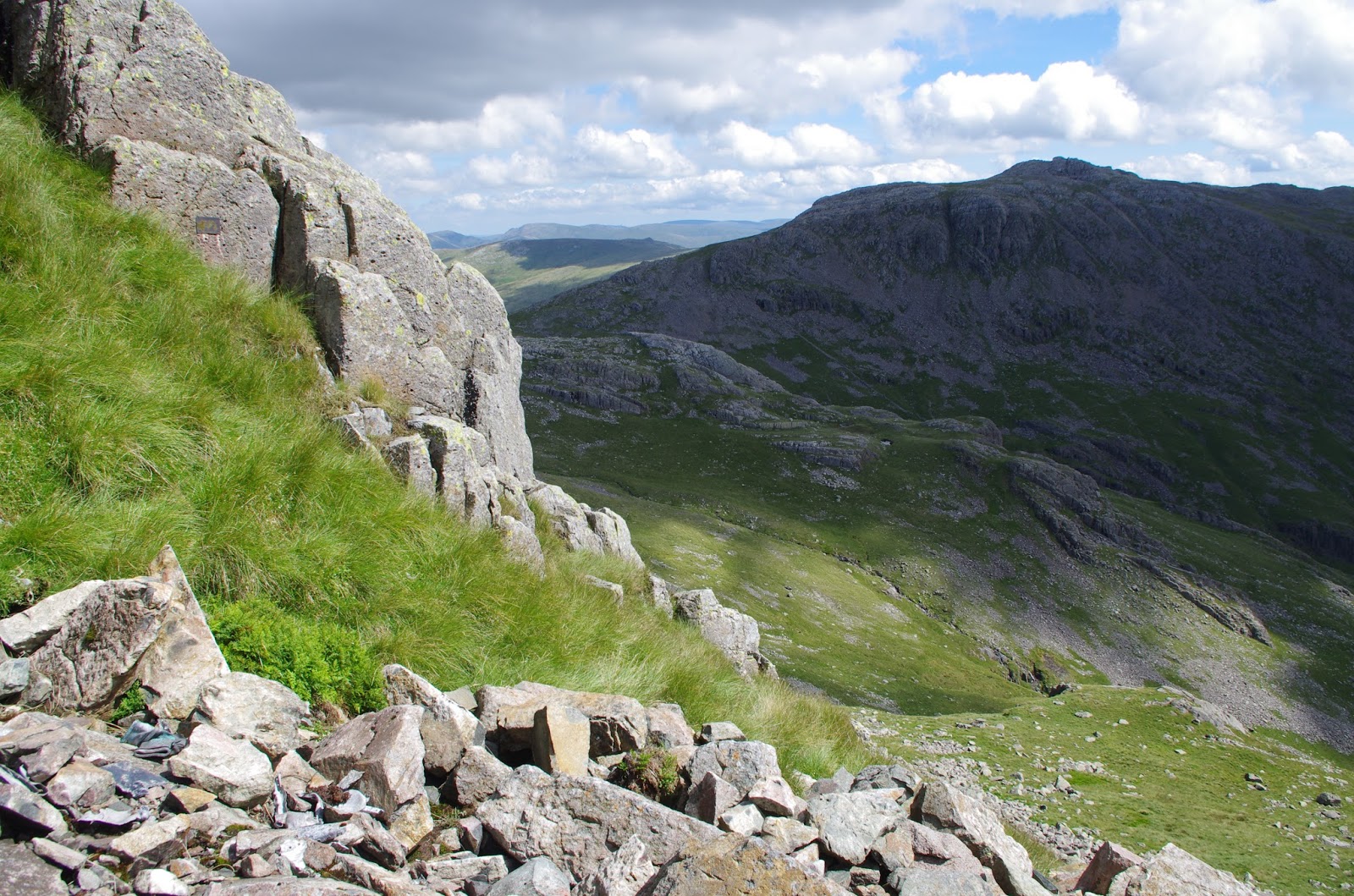
The Hill the Reverend John Toft cycled up and the view behind of The Caldbeck Fells. Left to right; Carrock Fell, High Pike (centre) with Brae Fell, Great Sca Fell and Knott over to the right.

**************

**I have previously published this account, and other new material, for public knowledge. I did so in the expectation that anyone wishing to further expand that public knowledge would do so by highlighting this original account, and then adding new information they discover themselves. Sadly I am aware of one site that has repeated a large section of an account of another all but forgotten lakeland memorial to two boys that drowned and making out it was new, despite his following my many new lakes history accounts. I was asked by a person writing a book for Wasdale MRT for the generation of funds to assist that worthy cause. I gladly agreed to its use and he stated he would reference my original account. Such a stance by the latter is an honourable one; I hope the former person reflects on his conduct and no longer copies my work and then makes out he has found a new lakes history; that is dishonourable and diminishes him.**
(C)opyright


Tuesday, 10 November 2015

Fanny Mercer - Fleetwith Pike

Most Lakeland walkers to Buttermere Valley will have at some time become aware of the white cross on Low Raven Crag, near the base of Fleetwith Pike. The cross becomes a draw to the curious who are interested in any marker of history in Lakeland.

A winter view of Fleetwith Pike, from the lake path out of Buttermere

Fleetwith and Low Raven Crag.

The Fanny Mercer Memorial Cross below Low Raven Crag
The inscription reads:

'Erected by Friends of Fanny Mercer.
Accidentally killed 1887'

Very little has been written however on the circumstances of how the tragedy happened, beyond she fell while carrying an alpenstock.
Fanny was born in the second quarter of 1869, in Rugby, Warwickshire, and was baptised on 28th July of that year. Her parents were Thomas, a painter by trade, and Anne (nee Shortridge). Fanny was the oldest of four children and her younger siblings in order were, Thomas (Tom), Mary Ann, and Mabel.
Fanny Mercer was in service to the Reverend P. Bowden Smith a master at Rugby School who resided at Barby Road, next to the school itself. The family and their three servants holidayed in the Lake District, stopping at Wood House on the shores of Crummock Water, the Bowden Smith's having holidayed there for five consecutive years. The servants were a Clara Tamer, Walter Clarke (the butler|) and 18 year old Fanny Mercer. To Fanny, it was an adventure for she had never been away from her native Rugby, and here she was in the beautiful and exotic valley of Buttermere; an adventure to savour and be thankful to her employer for the opportunity his employment afforded her.

After dinner on Thursday 8th September 1887, the three servants set off from Wood House and went by the Scarf Gap track to the top of Honister Crag, where the famous slate quarry is situated. They reached the summit about four p.m., and commenced their descent towards Gatesgarth by Raven, or Low Raven, Crag. Clara Tamer was leading, Walter was about six or seven yards behind, and Fanny was a few yards further at the rear. This placed her as highest on the ridge, and Clara lowest, Walter being between them. Fanny was going to get down to where Clara was standing, and took hold of her alpenstock close to the top. She leaped off the ledge on which she was standing, but instead of sliding her hands down the alpenstock she clung to the top, with the natural consequence that she was carried a considerable distance farther than she had anticipated. She jumped right over the Walter’s head, twisted round, and fell backwards a distance of 20 feet, striking with her head on a rock. She then rolled 130 feet down the steep mountain side. The instant Walter saw how his companion was jumping he caught hold of her dress to try to hold her. This was impossible, and a portion of the garment was torn off and left in his hand. A young man was working near to the place where she finally came to rest, and he went at once to her, but she was unconscious. Her companions went down and assisted to carry her to Gatesgarth, about a quarter of mile away; two of Bowden Smith's sons were passing and also  assisted. A mounted messenger was quickly sent to obtain the services of Dr. Forsyth at Cockermouth, about a dozen miles away. The Rev. S. Atlee of Buttermere and his guest the Rev. T.T. Smith, who had some surgical skill through his North American missionary work, attended in a carriage from The Victoria(now known as The Bridge) Hotel, Buttermere. They did all that could be done, but she died after about four hours, and before the doctor's arrival. The back of her head was terribly injured, but her face was only slightly bruised and no other bones were broken. 
The next day an inquest was held by the Deputy Coroner of Cockermouth, Mr. John Simpson, at Gatesgarth. Rev. Bowden Smith identified the body and said he had last seen her alive at 9am on the Thursday. He had been on the lake when he heard of the accident and had then immediately made his way to Gatesgarth Farm. After the above circumstances had been given to the inquest, the jury, with the Farmer Mr. Rudd acting as the jury foreman, returned a verdict of Accidental Death.

Gatesgarth Farm, where the inquest took place.
On Monday 12th, the body was transported to Keswick for departure on 4:12pm train, and returned to her native Rugby. 

The funeral took place in the Rugby Cemetery on the afternoon of Wednesday 14th, in the presence of a large concourse of sympathising spectators, the burial service being read by the Rev. J. Murray. Some of the deceased’s fellow servants acted as pall-bearers, and others followed with the mourners. Among the floral tributes were beautiful wreaths from Mrs. Bowden-Smith and family.

In time a cross was erected by her friends to commemorate her passing. 

Low Raven Crag and the Cross, bottom left of the crag.

Close up of the cross and the Mountain Rescue donation box.


For such a young ordinary working class family member, the memorial cross would become one of the most well known markers of tragedy in the English lakes, forever memorialising the name of the young girl and anchoring her name in Buttermere.

For the Mercer family, Tom became a teacher of music, specialising in the violin and Cello, and married a Swiss lady called Bertha Niggeler; they had three daughters. Mabel was a dressmaker and died a spinster in 1943 aged 67 years. Mary Ann married a watchmaker called William George Steele and they had three daughters. Tragically another death occurred for the Mercer family with the passing of Mary Ann, aged 37 years, only a year after the last child, Hilda Eileen, was born. This last child appeared to be too much for William George to care for and she appears to have been raised by her Mercer grandparents. Both lived to a good age, Ann dying aged 80 in 1930 and Thomas 5 years later aged 90. 

****************


(C)opyright.

Saturday, 22 August 2015

A pair of clogs, a pair of stockings and two empty chairs at Loweswater School

On a previous publication on this site dated 5 March 2015 I explained how I researched  an event referred to by Wainwright in his walking guide books. As little information was available on this incident I visited Whitehaven Archives to research it and was successful. Whilst researching, there was one other incident that caught my attention and again refers to the Loweswater Valley. I will initially give some idea of the location as the terms are not overly familiar to anyone other than local people and even then a farmer I spoke to did not recognise the beck referred to. I am however more than satisfied that we are talking of the area in and around what is now generally referred to as Maggie's Bridge which is the National Trust car park for visitors to the Eastern end of Loweswater. We see here on the old map below, the key areas of the account, Stockbridge, Mill Hill and High Cross. The school referred to is not the one converted into the village hall, it was erected in 1839, 36 years after this event; it was what is now called Rose Cottage which lies a little lower down the hill toward Scale Hill direction and is off this map. Note there is no reference to Maggie's Bridge, just Stock Bridge which I believe is a separate one and leads to Mill Hill.

Old map showing Mill Hill, High Cross and Stockbridge.
For a story over two hundred years old the writer could embelish the tale to try and add something to make the account touch the emotion of the reader. There was however an eyewitness to the events of that day and his account, given here in full with (hopefully) just one undecipherable legal word, requires no such writers embelishment:

'John Head of High Cross in the County of Cumberland Esq. being Sworn and examined deposeth & siath that yesterday morning about eleven o'clock he was crossing the Rivulet called Stock Beck in Loweswater on horse back it was then swollen with the rain which had fallen the night before and the water ran over the top of a foot bridge across this Beck a little but not so deep as it has at some other times that he passed by a pair of clog shoes and stockings laying on the North End of the Bridge and he went forwards to Thomas Clarkes house at Mill Hill about 200 or 300 yards from the South side of the Rivulet and there informed the family that he had seen the clogs and stockings & enquired if any of the children had gone over when he was informed that Jane and Isabella Clark two infants the former 9 years of age and the other about 6 years of age had gone to the school which is at Rose Bank on the North side of the Rivulet and he went to the school aforesaid to enquire if the children were there but they had not been at school that day on which a suspicion arose in his examinant mind that the children aforesaid had fallen into the Rivulet and  a search was immediately made in the Rivulet & the Bodies of both these infants were found in the Rivulet below the Bridge Dead that means to restore animation were used but without effect as the accident had happened more than two hours before as he computes & the Limbs and joints of both the Bodies were stiff before they were taken out of the water

John Head

The above is a witness statement dated 26 November 1806 and was attached to the inquest document of Jane Clark(e). Both inquests were heard by the Coroner Thomas Benson with a 12 man jury drawn from the locality, at the Clark family home Mill Hill, Loweswater, the tragedy occurring on 25 November 1806. A summary of both inquests is that they died 'casually accidentally & by misfortune' - in modern terms a verdict of Accidental Death.

The entry in the Loweswater Parish Burial Register,
The burial Register entry above reads:

'Jane and Isabella Daughters of Thomas Clarke of Mill Hill Labourer they were Drowned in Stock Beck on the 25th November and Buried 27th

It is a terrible event to read in such eye witnessed detail but when you can remove yourself from the emotion, particularly being a parent oneself, you can see an insight into the lives lived by people in those days. Checking on modern mapping systems the distance from the house at Mill Hill to the crossing is approaching 500 metres and the total distance to the school was 1.4 kilometres, just short of a mile.

Rose Cottage, the former Rose Bank school the Clarke sisters attended.
Following my interest on the Crabtree Beck article I passed on the detail to the 'Lorton & Derwent Fells Local History Society' who referred to it in their most recent newsletter. I have since checked through their previous journals and it appears that John Head, the discoverer of the clogs, stockings and then sadly two bodies, was the owner of Mill Hill (though he lived at High Cross), inheriting it from his father in 1789. The first paragraph of  'In Search of Loweswater’s Corn Mill' on page 10 of number 46 of the journals refers to Mr Head and Stock Bridge being near Maggie's Bridge.

http://www.derwentfells.com/pdfs/journal/Journal46.pdf

The link above is the reference to this article and these journals are very informative on the Lorton and Derwent Fells history.

Stock Bridge is itself on private land, as is Mill Hill. This Mill I understand to be a ruin or is now just one barn following a fire and I was told locally that the stone was used to build further on High Cross.
 I managed to view what I believe is the Stock Bridge; if I am correct then it is a substantial structure, though it appears to have no sides. If this was the bridge at the time then the water must have been at some height and according to John Head, historically and within his personal experience, it was known to have been higher. Certainly the bridge I viewed was on the track to Mill Hill, though perhaps it was raised after the tragedy?

We were not there so do not know the full detail of the terrible chain of events that led to the tragedy but with the evidence of only one pair of clogs and one pair of stockings being found by the bridge it seems reasonable to speculate that one daughter, most likely the younger Isabella, got into difficulty and was taken by the current. Jane being the older would feel that sense of duty to her younger sister and remove her clogs and stockings (no doubt valuable commodities to a labouring family) and try and get Isabella to safety, but she herself would also be taken by the current and cold November flood waters. Perhaps it was the other way around, but there appears little doubt one tried to rescue the other but failed, with a double tragedy for the Clarke family.

Walk the tranquil valley, go up onto Melbreak, Hen Comb, Carling Knott or Low Fell and cast an eye down to the tranquil valley below, Crabtree Beck and Stock Bridge show it wasn't always so.

*****************


**I have previously published this account, and other new material, for public knowledge. I did so in the expectation that anyone wishing to further expand that public knowledge would do so by highlighting this original account, and then adding new information they discover themselves. Sadly I am aware of one site that has repeated a large section of an account of another all but forgotten lakeland memorial to two boys that drowned and making out it was new, despite his following my many new lakes history accounts. I was asked by a person writing a book for Wasdale MRT for the generation of funds to assist that worthy cause. I gladly agreed to its use and he stated he would reference my original account. Such a stance by the latter is an honourable one; I hope the former person reflects on his conduct and no longer copies my work and then makes out he has found a new lakes history; that is dishonourable and diminishes him.**

(C)opyright

Thursday, 20 August 2015

Wordsworth's Hart Leap Well; Richmond North Yorkshire.

This will perhaps be seen as a deviation from my normal walking area and in fairness, this was not to be a walking weekend away from the lakes. It was a trip to split a journey to Nottinghamshire and spend a few days away in my recently acquired caravan (straight admission, I am now a caravanner!). We parked near Scotch corner in the Caravan Club Park, this being North Yorkshire, but those that know me will know the lakes are never from my thoughts. For a number of years I was aware of a journey Wordsworth and his sister Dorothy took through Richmond towards Askrigg and on through Wensleydale on their journey to Grasmere and home at Dove Cottage.
Five miles out of Richmond on the Barden Fell Road they passed a location and three stones that caught his eye. On speaking to a local Shepherd he was made aware of the story or local legend to this location, that being Hart Leap Well.
The poem is 45 verses long, each of four lines and the poem is in two distinct parts. The first tells the tale of Sir Walter as he chases a magnificent Hart all day wearing out the other hunters, the dogs and three horses. The Hart eventually succumbs and is killed at this location, Sir Walter honouring it through:

'Three several pillars, each a rough hewn stone,
And planted where thy hoofs the turf have graz’d.'

He also erects an arbour and honoured the Hart and the pursuit it gave him until eventually he himself died and was buried in the Vale.
 ----------------------------------
If this seems too gruesome or distressing a topic for some, it is well worth the read as the second part is Wordsworth's finding of this place on his journey with Dorothy across this moor, heading to Wensleydale. In the second part of the poem Wordsworth describes how he found the place and speaking with a local Shepherd is told the legend, that is this first part. He then goes on to describe the landscape and how Nature itself remembers the events of that fateful day:

'I look’d upon the hills both far and near;
More doleful place did never eye survey;'

It must be considered by the reader that anti blood sports is not a new phenomena of 20th or 21st century, but has roots also in the Romanticism period that Wordsworth was a leading light in. He continues to discuss with the Shepherd the air that now exists in this place and I will leave it to the reader to gain fully through that reading of the poem, the full sense of what he felt and how it moved him. The final verse is worth the publishing here as it seems to dig right into the soul of Wordsworth himself:

'One lesson, Shepherd, let us two divide,
Taught both by what she shews, and what conceals,
Never to blend our pleasure or our pride
With sorrow of the meanest thing that feels.'
  
The 'she' being 'Nature' herself, or at least is my interpretation. Below is the link to the poem:


I went across to Richmond about 10 years ago to try and locate this site but incorrectly took the Swaledale Valley and found three pillars toward the river Swale, although they looked too new for Wordsworth's time. I now know it was not them and the six figure map reference for the well is SE135965. We went on  a cold wet very drab day and initially I was very disappointed with the weather, yet considering the way in which Wordsworth describes it on his passing it now seems the most appropriate weather for it. Nothing now remains of the well or the scene as the poet found it; Richmond being an army town with Catterick Base nearby, this is a tank training area.

 I include below the photographs I took.

Looking South East to the entry to the training area and the top of Barden Fell. The Road to the left is to Richmond, to the right Askrigg.
The concrete area viewed above, possibly the drain had something of the location of the well?

The view to the right

Turning round and looking across Swaledale

The view of the road as Wordsworth journeyed toward the well, note the abandoned tank on the fell top.
I do believe I found the scene more desolate than even Wordsworth did; it would appear Nature still hasn't forgot the day of the hunt.

It seems strange to me that the people of North Yorkshire and especially those of Richmond have not in some way marked this location as the scene of a poem which is from the father of Romanticism, even at the Tourist Information centre, now in Richmond Library, the people were unaware of it's location nor had any knowledge of it, though in fairness it is run by volunteers now, as I am led to believe. Somewhere on the internet I would have thought some local person/historian would have made this place memorable, but there is very little except for writers of a bygone era. For a much researched poem, having discussion pages to it's name, pouring over each lines very meaning, nothing notes it in the landscape, nor is it shown on the OS 1:25000 Explorer map. It is referred to in a book by Edna Whelan 'Holy Wells of Yorkshire' with the map reference given, so it is there.

Nothing remains of the well or the features Wordsworth found, but that does not mean it should be forgotten. I don't live in Richmond or North Yorkshire so I hope some resident in the reading of this, will pick up the baton and run with it until a more permanent reference is made at the side of the road and in local literature, of the link to one of Wordsworth's famous pieces of poetic literature. I would also ask that those who comment on any view to hunting, do so in the knowledge that such methods now are not practised in this country; any view expressed ought to be on the literal aspects, not moral ones.

                                                            ********************


**I have previously published this account, and other new material, for public knowledge. I did so in the expectation that anyone wishing to further expand that public knowledge would do so by highlighting this original account, and then adding new information they discover themselves. Sadly I am aware of one site that has repeated a large section of an account of another all but forgotten lakeland memorial to two boys that drowned and making out it was new, despite his following my many new lakes history accounts. I was asked by a person writing a book for Wasdale MRT for the generation of funds to assist that worthy cause. I gladly agreed to its use and he stated he would reference my original account. Such a stance by the latter is an honourable one; I hope the former person reflects on his conduct and no longer copies my work and then makes out he has found a new lakes history; that is dishonourable and diminishes him.**


Tuesday, 11 August 2015

The Wad Mines of Seathwaite, Borrowdale.

Seathwaite has been my default starting point when setting off for a fell walk giving access to the iconic high fells of Scafell Pike, Great End, the Glaramara Ridge, or Great Gable. You can also access Kirk Fell or the Langdale Valley, so there is variety from this relatively easy location for me to reach and a certainty for free parking, whatever the time of year, if you get there relatively early. Though for all I've walked the area, it has only been these last couple of years that I have visited the spoil heaps that are layered like steps, up the right hand side of Sourmilk Gill/Gillercomb. These are the Wad/Black Cawke or Plumbago Mines, that were the birth of the world famous Keswick Pencil Factory, though Wad had it's many uses with respect to moulding, casting dyes and weaponry. Napoleon was not a happy man when deprived of this source, the best quality Wad in the world. Wad, graphite is one of the best dry lubricants and in a previous occupation in the foundry industry it was used in the moulding process. If ever you coated your hands in 'plumbago' it was impossible to retain your grip on anything.

Although taken from a different aspect, you can make out the spoil heaps, layered up the fell.
While at the base of the fell you are also not too far away from 'The Fraternal Four of Borrowdale', the yews mentioned after the Lorton Yew in Wordsworth's Poem 'Yew Trees', though that is for another write up one day.

The Wad (Plumbago) Mines

This is a good alternative route onto Green Gable via Grey Knotts and Brandreth, making a change from the more usual Gillercomb hanging valley route. You will see the first spoil heap jutting out, covered in grass between the trees and wall and is known as Robson's Stage. Rising higher toward the grey spoil heaps you come to Gilbert's stage with the John Banks marker stone to it's left.


John Banks
Efquier 175(2)

Many mistakenly think of this (there were originally 5) as a memorial stone yet it is a boundary marker. Due to robberies at the mine and pilfering of this very expensive material, an Act of Parliament was passed making it a specific offence to steal Wad with a maximum penalty of 7 years deportation.

The relationship of the marker with the Gilbert's Stage
To carry on up the fell you pass other stages, crossing the top fell wall via the steps, reaching a number of other levels before moving on to Grey Knotts. There is however one further marker that seems to have eluded people. I found this coming at the mine from the other direction, down from Grey Knotts.

John Sheperd
Esquire
1752
Note the same date yet alternative spelling, clearly not done by the same carver. Sheperd was another owner of a level. Having found this stone I began to take an interest in the Wad Mines and bought the book 'Seathwaite Wad' by Ian Tyler. This gives a very in depth history of the mines and well worth a read. For those not wishing to miss this marker, (referring to a map and not a GPS) the reference will be NY229128. It is basically at the 'T' junction of the vertical and horizontal walls to the left of the mines, then 50 yards (or metres) straight up towards Raven Crag. You can see a small pool on the OS maps.

The Sheperd marker with the pool, the higher Wad Stages just beyond the boulder and Dale Head in snow.
As can be seen, this is very fragile, being there for over 260 years and clearly should not be touched.

Wad/Black Cawke/Plumbago.

Above is a sample I picked up off the spoil heaps.

NOTE OF CAUTION - These mines are open and marked with 'deep excavation' yellow warning markers.

From the Sheperd marker stone it is easy to swing round to the right and find a safe route onto Grey Knotts, leading to Brandeth and then Green Gable. At the summit look out for the Avro Anson crash site near here. You can see the impact scar in the rough direction of Styhead Tarn (though more information about this again, I intend another write-up). Now it is simply a question of deciding if you head for Base Brown/Gillercomb, or onto Great Gable. Whatever you choose, all the best, I hope the weather remains fine and you have a little more knowledge on a very important historical industry that helped shape Keswick's name as the manufacturing centre of the world famous Keswick Pencil.

********************


**I have previously published this account, and other new material, for public knowledge. I did so in the expectation that anyone wishing to further expand that public knowledge would do so by highlighting this original account, and then adding new information they discover themselves. Sadly I am aware of one site that has repeated a large section of an account of another all but forgotten lakeland memorial to two boys that drowned and making out it was new, despite his following my many new lakes history accounts. I am aware he has visited this previously not photographed Sheperd stone, with others, despite seeing it first on my FB page and noting it. I was asked by a person writing a book for Wasdale MRT for the generation of funds to assist that worthy cause. I gladly agreed to its use and he stated he would reference my original account. Such a stance by the latter is an honourable one; I hope the former person reflects on his conduct and no longer copies my work and then makes out he has found a new lakes history; that is dishonourable and diminishes him.**


Sunday, 9 August 2015

Supermarine Spitfire Mk XVI SL611 (Ill Crag) & De Havilland Dominie X7394/'Merlin V' (Broad Crag)

I have walked from Seathwaite on hundreds of occasions now over the last 12 years and as time passed I became increasingly aware of the aircraft crash sites in the area and set about to visit these and others in Lakeland. This Supermarine Spitfire has evaded me in the past, attempting to search it out on three previous occasions (once forgetting my maps, compass and GPS and others by rain/cloud and snow). I was adamant on this occasion to locate it and then move on to the De Havilland on Broad Crag. The route up Grains Gill was uneventful on this warm clear day, eventually turning to Esk Hause below Great End and then taking the path that comes out above the Hause.

The view south from Esk Hause to Harter Fell.
The path to Ill Crag, Great End now on the right.
 From here it is a right turn for Ill Crag and Scafell Pike, however once up the steeper 'Fix the Fells' stepped path and onto the boulder field, it is here you need to head over to the left and begin to descend to map reference NY225077 which is a drop off of approximately 50 metres. Try and do this in the dry weather as it is a scree slope, you may begin to find debris on the scree yet the impact scar and main remnants are against a rock face, though there is not much left.

Beginning the descent, Esk Pike in the near distance.

I think she's spotted something!

The wreckage in relation to Esk Pike, note the square on the rock-face, the plaque.

The plaque

HERE LIES THE REMAINS
 OF SPITFIRE SL611
IN WHICH
F/LT D J O LOUDON
***LY LOST HIS LIFE 20 11 47
LEST WE FORGET

This is a view of the impact site, looking towards Ill Crag.
 F/Lt Donald James Ott Loudon (25yrs of age) was an instructor who was en route to Turnhouse (now Edinburgh airport) when he struck Ill Crag on Scafell Massif. When he didn't arrive a search was mounted but scaled down after a few days. The Spitfire and his remains were eventually found by a shepherd boy called Richard Ellwood, of Taw House Farm, near Boot, on 1 May 1948, a time gap of 163 days. He is buried at Halton (St. Michael) Churchyard, which I believe is Cheshire.

*****************

From here I moved back up to the Scafell Pike path that skirts the south of Broad Crags. I would advise not doing this as the route and instead visiting this site by either dropping down between Great End and Broad Crags, or if visiting this only, approaching from The Corridor route to Scafell Pike and branching off at Greta Gill, south of Round How. To come over the top of Broad Crags exposes a person to cliff faces and at least one deep gulley. I was beginning to think this was actually up on the cliffs, but I sighted one of the engines on a relatively flat grassy section and then spotted the other further below and to the east. 

Impact scar, Great Gable beyond.

If you head for map reference NY217070 and look towards Great Gable, you should see both of the engines.

The higher engine.

Debris previously gathered and secured behind nearby rocks.
Looking to Styhead Tarn and the lower engine

The lower engine, Hollydog giving a scale.
This plane was acting as an air ambulance, of Royal Navy in Fife. It was transporting a seriously ill patient to Rochester on 30 August 1946 when it struck the mountain on the Scafell Massif, killing all five occupants including the surgeon. Like most of the crashes in the lakes it was attributed to bad weather and having to come down to get under the cloud to get a fix on location; no doubt they wrongly believed themselves clear of a mountainous area.


Sub Lt. Sydney Kenneth Kilsby Pilot (24) - Buried Dunfirmline
CPOA (Chief Petty Officer Airman) Harold John Clark (25) - Cremated South London
Cdr Surgeon William Tudor Gwynne -Jones (54) - Buried Plymouth
Sick Birth Attendant Leslie Howard Watkinson (19) - Owston (All Saints) Churchyard
Commissioned Ward Master Charles Robert Allwright DSM (The patient) (61) - Buried Dunfirmline (Douglas Bank) Cemetery

Sadly the mercy run to save a seriously ill patient ended in tragedy for all on board. Thousands walk The Corridor route to Scafell Pike and never know what they are passing.

*******************


(C)opyright


Saturday, 4 July 2015

Heaven in Lakeland and Hell on the North Sea.

Heaven in Lakeland
The Lake District has long been renowned for it's natural beauty though for a real sense of it's splendour this normally means an arduous walk to the higher peaks such as Great Gable with it's panoramic views of Wasdale, Ennerdale, Buttermere and through to The Langdale Valley. Occasionally you can get a sense of that Splendour from some smaller fells, Hallin Fell being one of the finer examples and to drive down the eastern side of the lake, past the famous Sharrow Bay Hotel and up the hause to St Peter's Church, Martindale where you can park your vehicle, or on the roadside under the fell.

St Peter's Church, Martindale
 The beauty of this fell is the stunning and panoramic view one gets as the lake arcs round it's northern edge, coupled with the iconic Roman High Street ridge stretching from Penrith to Ambleside.

The Obelisk cairn on Hallin Fell , looking North-east to Pooley Bridge

This fell summit can easily be accessed with it's height only 388m, yet to park at the hause, near the church, the walker is already at a height of 230m so only has to ascend 158m to reach the top, capable of accomplishing between 15 - 30mins and if it takes longer, who cares?
The bottom fell route in the Howtown direction.
For those who wish to extend their walk or don't feel the top is for them, there is the more gradual anti-clockwise walk around the fell, from St. Peter's church.

Looking across Ullswater to the right of Gallowbarrow Bay 
As one skirts round the lake you begin to get the northern view over to Gallowbarrow bay and it was along this northern shore that Wordsworth and his sister Dorothy walked, she penning the walk in her journal and he writing his famous daffodils poem some years later, based on Dorothy's entry at the time.

The steamer plying it's trade, heading from Glenridding to Howtown
While on this walk you cannot help but see the steamer making it's seemingly endless shuttle up and down Ullswater's full length, England's second largest lake. This lake trip is well worth the purchase of the ticket and can be a return route for a lake walk.
 As the title describes this is a heavenly trip out to revitalise a soul.

Hell on the North Sea. 
HMS Glorious was a First World War Courageous Class Battle Cruiser which was converted in 1920's to an aircraft carrier

The converted HMS Glorious


HMS Glorious assisted in the evacuation of Norway taking on board 46 Squadron Hurricanes and with permission, on 8 June sailed independently for Scapa Flow escorted by HMS Acasta and HMS Ardent. This is not meant to be an analysis of the naval battle that followed, it is enough to say that the ships were located by the battleships Gneisenau and Sharnhorst and after a battle at sea and despite the the heroic efforts of the two escorts who sacrificed themselves for Glorious, the three ships were sunk with a loss of over 1,500 lives, only 45 survived three days in lifeboats.
This is the Youtube link to the German footage of the sinking:

https://www.youtube.com/watch?v=GUy2uwoAPU4


The Link
At the bottom of the fell the walk begins from St Peter's Church. This was built in 1880 to replace the old church of St. Martin which is beyond the hause, in Martindale. St Peter's was built through the generosity of the Parkin family, Anthony Parkin of Sharrow Bay, and W.H. Parkin of Ravencragg, both on the road up to the church. On board HMS Glorious was Lieutenant Commander W.H. Parkin who lost his life as one of the crew.

http://www.cwgc.org/find-war-dead/casualty/2975028/PARKIN,%20WILLIAM%20HUGH

In 1970's the majority of the windows were replaced and the designs were by the artist Jane Grey. One of the windows is an airman's view of HMS Glorious. The inspiration for the window was apparently a comment from a female member of the congregation who had stated that she would like a memorial to her husband, who had been drowned in the war.


Above is the window and I have included a bigger photograph showing the dedication at the base. 

The window has a plaque of explanation next to it that reads:

'This window is dedicated to St. Nicholas a fourth century Bishop of Smyrna who is patron saint of sailors and children. It is in memory of the officers and men of the aircraft carrier HMS GLORIOUS sank in Norwegian waters in 1940. The ship lie s along the length of the window, cleaving the seas with the stars of heaven above. Amidships is the badge of The Glorious and above it the Pheonix bird which renews itself perpetually in the flames, a symbol of Resurrection. Beneath is the Anchor of Christian Hope, and the three bags of gold on the open book of The Gospel are the arms of St. Nicholas. At the foot the inscription.'

So if ever you are walking in this heavenly part of The Lakes, stop by the church and perhaps pay some respects to the men that faced that hellish naval barrage. They paid the ultimate price to allow you that freedom. The door is stiff, but should be open, don't forget to drop a donation in the church collection for that privilege. 

****************

The Parkin family have associations with Holy Cross Church, Berstead, Kent, and a window in that church shows St, Nicholas carrying an object; the object is the aircraft carrier HMS Glorious.


(C)opyright